
When choosing LED light strips, you’ll encounter options for voltage selection. There are low-voltage 12V and 24V options, and high-voltage 110V-240V options. Today, we’ll learn about high-voltage LED light strips. High-voltage LED light strips have become a popular choice for commercial and residential lighting due to their advantages, such as high brightness, long-distance power supply, and convenient installation. Among the many high-voltage light strips, 110V and 220V LED strip light are the two most common voltage types. Many users ask when purchasing: Which one is safer? Which one is more suitable for my application scenario? This article will provide an in-depth analysis of the differences, performance, and application suggestions between 110V and 220V LED strip light to help you easily make the right choice.
What are the Main Differences Between 110V and 230V LED Strip Light?
Both 110V and 230V belong to the category of “high-voltage LED strip lights,” but they differ significantly in their operating voltage, applicable regions, and electrical characteristics. The main difference lies in the countries that use high-voltage electricity. More details, pls read Niedervolt- vs. Hochvolt-LED-Streifenleuchten erklärt
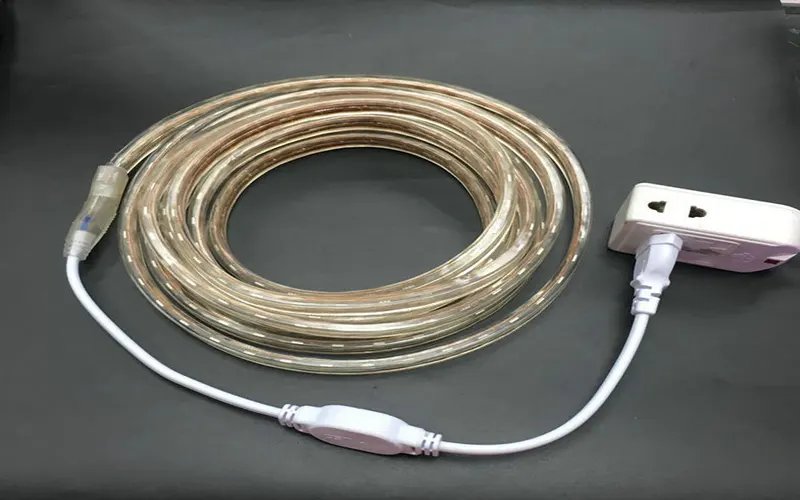
Operating Voltage Differences
110V LED strip lights are primarily used in countries with 110V power grids, such as the United States, Japan, and Canada; while 230V LED strip lights are suitable for regions with 230V power grids, such as China, Europe, and Australia. This is a significant difference.
Power Supply Distance and Voltage Drop Difference
From a power supply efficiency perspective, 230V LED strips, due to their higher voltage and lower current, offer a longer transmission distance and lower voltage drop. This means that, for the same power output, 230V LED strips are more advantageous for long-distance installations.
Power and Heat Generation
110V LED strips draw a higher current, potentially generating more heat during prolonged operation; while 230V LED strips draw a lower current, resulting in higher energy efficiency, lower temperature rise, and a longer lifespan.
Plug and Driver Compatibility
110V LED strips require a 110V plug and driver, while 230V LED strips can be directly connected to the local power grid (a waterproof plug and rectifier are required). The sockets used by the two individuals are completely different and cannot be used interchangeably.
Which voltage is safer? 110V VS. 120V LED Strip Light?
In principle, high-voltage LED strip lights are indeed less safe. 12V and 24V LEDs are definitely safer. Safety is the most crucial factor to consider when choosing high-voltage LED strip lights.
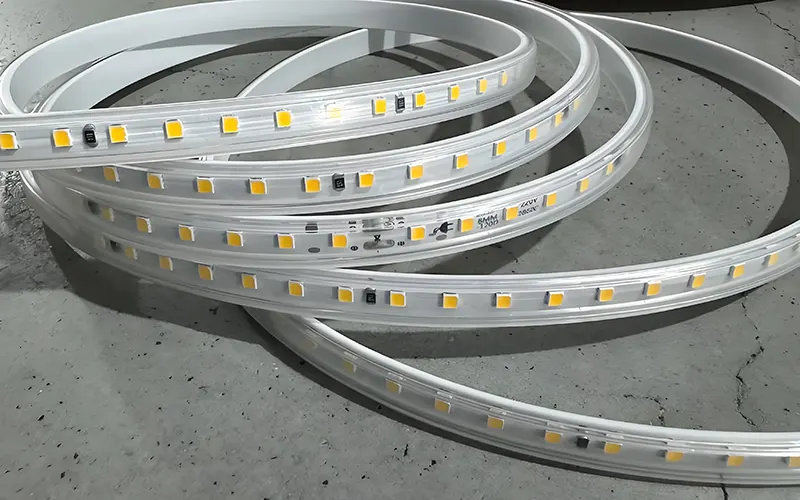
Inherent Risks of High-Voltage LED Strips
- Electric Shock Risk: Both 110V and 230V voltages are far higher than the safe voltage for the human body (generally considered to be below 36V). This means that when the strip is in operation, any damage to the insulation, negligence in cutting points, or improper connections can lead to a serious risk of electric shock.
- High Waterproof/Dustproof Requirements: High-voltage LED strips have extremely high requirements for sealing and insulation protection. They are typically encased in thick PVC or silicone tubing (meeting at least IP65 or IP67 standards) to prevent moisture and accidental contact. Never buy IP20 high-voltage LED strips; that’s far too unsafe.
Safety Precautions:
Professional Installation: Wiring and installation by a professional electrician are strongly recommended to ensure all connections and terminals are professionally insulated and sealed.
Keep Away from Contact Areas: High-voltage light strips are typically used for contour lighting in outdoor locations, eaves, or large commercial spaces where they are difficult to reach by hand.
Compared to Low-Voltage: Although high-voltage light strips are structurally designed with insulation protection, they must be IP67 waterproof.
Why Use High-Voltage 110V-240V LED Strip Light?
While high-voltage LED strips are less safe than low-voltage strips (such as 12V oder 24V), they outperform in several ways.
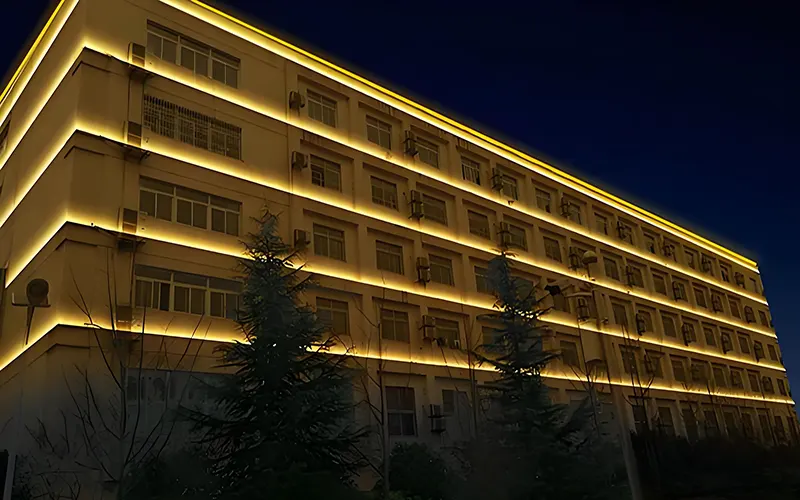
- No external power supply required: It can be directly connected to AC power, making connection very convenient, and installation is also simple.
- Longer power supply distance: A single 230V LED strip light can provide a power distance of over 50 meters, making it ideal for outdoor facade lighting.
- High brightness and high power: Ideal for outdoor lighting and commercial lighting, and its application has proven very successful.
- Saving wiring costs: Reduces the number of power supplies and connection points, which is the fundamental reason for cost reduction.
- Good waterproof and weather-resistant: Suitable for outdoor facades, corridors, bridges, and other similar applications.
110V VS. 120V LED Strip Light, How to Choose?
After understanding the differences between high-voltage and low-voltage LED strips, you can make the best choice based on your specific needs. Of course, this is just a reference; the actual choice depends on the project, cost, and the desired effect.
| Application Scenarios | Best Choice | Reasons |
| Outdoor Long-Distance Lighting | 110V / 230V LED strip lights | Solved the voltage drop problem, longer single connection length, reduced wiring complexity and cost. |
| Indoor Cabinets/TV Backdrops | 12V / 24V LED-Leuchtbänder | Maximum safety, flexible cutting points, and a compact size for easy concealment. |
| Ceiling | 12V / 24V LED-Leuchtbänder | luminous efficacy and flicker control, the low-voltage system provides a more stable constant current output. |
| Areas requiring frequent contact or bending | 12V / 24V LED-Leuchtbänder | 12V/24V Low-Voltage LED Strip: The risk of electric shock during maintenance and use is virtually zero. |
How to Ensure the Long-term Safety and Stability of 230V LED Strip Lights?
- Choose certified products: Check for compliance marks such as CE and RoHS;
- Use high-quality power plugs and waterproof end caps;
- Avoid excessively long continuous connections (single segment recommended not to exceed 50 meters);
- Maintain good heat dissipation: especially in enclosed environments;
- Aim for a waterproof rating of IP67 or higher; avoid using IP20 directly.
Schlussfolgerung
Choosing between 110V and 230V LED strip light is a comprehensive decision based on regional standards, project requirements, and installation conditions. Generally speaking, 110V LED strips are more suitable for small-scale, short-distance applications or use in North America, while 230V LED strips perform better in long-distance, outdoor, and commercial lighting projects.
If you need low-voltage LED tape lights, please consult NEONLEDSTRIP.
FAQs
Brightness is not significantly affected by voltage; it mainly depends on the LED chip type and density. Generally, for the same power and number of LED chips, the brightness difference between 110V and 230V LED strip lights is minimal.
Yes, just choose a strip light with an IP67 or higher waterproof rating to ensure good moisture and dust resistance, and use it with a waterproof power connector.
No, it’s quite simple. 230V LED strip lights typically only require a plug controller and don’t need an additional power adapter, making installation relatively easy.
Absolutely not! High-voltage LED strips must be strictly matched to their designed operating voltage. Connecting a 110V LED strip to a 230V power supply will cause a severe overload, the strip will burn out immediately, and may even cause a fire.