
Dans la conception architecturale moderne, de plus en plus de personnes accordent une importance particulière à la créativité et à la création d’ambiance. Avec les progrès technologiques, les bandes lumineuses LED de type néon sont progressivement devenues un choix très prisé dans le domaine de l’éclairage architectural. Par rapport aux néons traditionnels, les néons flexibles à LED offrent un meilleur rendement énergétique, une plus grande durabilité et une plus grande souplesse de conception. Elles constituent ainsi une solution d'éclairage courante dans les bâtiments commerciaux, résidentiels, paysagers et publics. Cet article explore en détail les meilleurs scénarios d'application, les principaux avantages, la conception et les techniques d'installation des néons flexibles à LED.
Qu'est-ce qu'un néon flexible à LED ?
Une guirlande lumineuse LED flexible de type néon (LED Néon Flex) est une bande lumineuse composée de puces LED, d'un circuit imprimé souple et d'une coque en silicone. Par rapport aux néons traditionnels, elle offre une meilleure souplesse, un meilleur rendement énergétique et une plus grande durabilité. Pour plus de détails, veuillez consulter Comment choisir la bande flexible de LED idéale ?
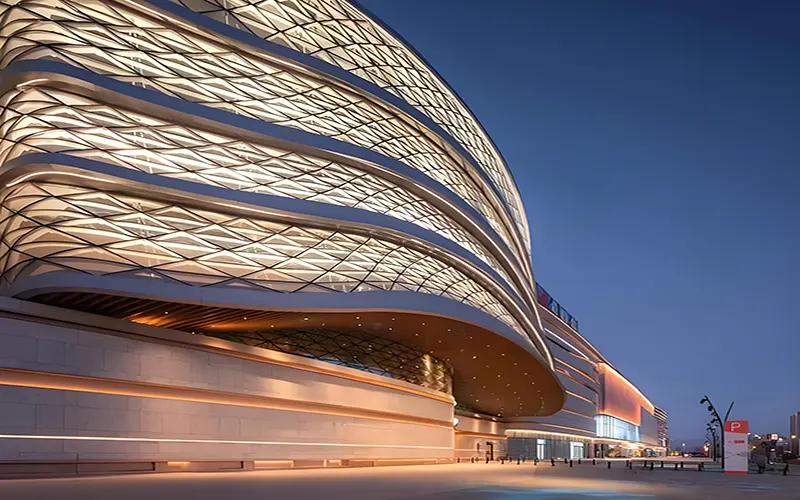
Grâce à la souplesse de leurs matériaux, les néons LED flexibles peuvent être facilement courbés et personnalisés pour s'adapter à diverses structures architecturales complexes. Ils sont ainsi largement utilisés dans de nombreux contextes d'éclairage, tant en intérieur qu'en extérieur.
Structure de base d'un néon flexible à LED
- Puce LED : source lumineuse utilisant généralement une technologie LED à haute luminosité et longue durée de vie.
- Coque en silicone : offre une protection étanche, anti-poussière et résistante aux hautes températures, adaptée à une utilisation en extérieur.
- Circuit imprimé flexible : confère à la bande lumineuse une flexibilité et une malléabilité exceptionnelles. Elle peut ainsi être adaptée à n'importe quelle forme en fonction des exigences de conception.
- Couleur des bandes LED néon flexibles : les configurations courantes comprennent les versions monochromes, RVB, RVB-W et celles offrant une température de couleur réglable.
- Luminosité des bandes lumineuses LED flexibles de type néon : la luminosité standard est de 10 W, soit 15 W par mètre, mais des configurations personnalisées sont également possibles.
Où les bandes LED Neon Flex sont-elles installées dans le domaine de l'éclairage architectural ?
Les bandes LED flexibles de type néon trouvent de très nombreuses applications dans l'éclairage architectural, tant en intérieur qu'en extérieur. Elles couvrent pratiquement tous les cas de figure nécessitant un éclairage linéaire de contours ou un éclairage de signalétique.
Définition des grandes lignes architecturales
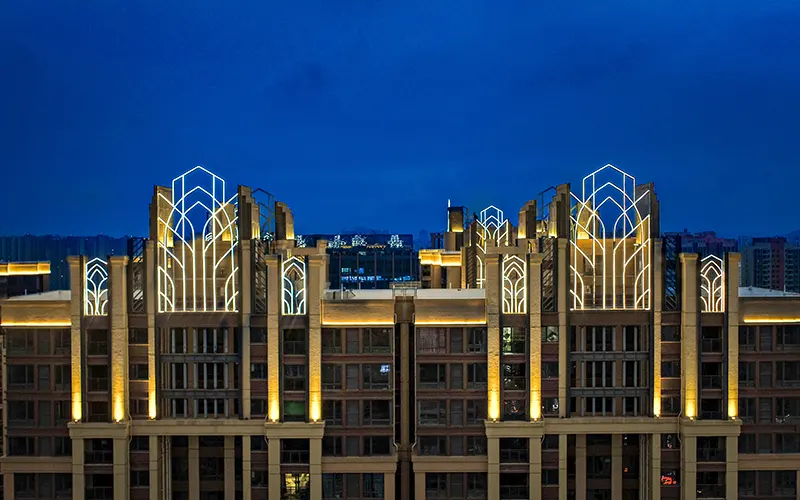
Il peut être utilisé pour mettre en valeur les contours d'un bâtiment, ce qui constitue son application la plus classique. Pour ce faire, on installe des bandes lumineuses sur les bords du toit, les encadrements de fenêtres, les avant-toits ou les colonnes. La silhouette majestueuse d'un bâtiment est ainsi clairement visible la nuit, ce qui lui confère une personnalité unique et une grande reconnaissance visuelle.
Signalétique commerciale et textes publicitaires
Sa facilité à prendre des formes complexes, telles que celles des lettres, en fait un support idéal pour créer des logos d'entreprise et des slogans publicitaires. Sa lumière douce et homogène produit un fort impact visuel, renforçant ainsi efficacement l'image de marque.
Éclairage architectural des façades et des espaces verts
Les tubes néon à LED permettent de créer des motifs artistiques ou des formes géométriques sur les façades des bâtiments. Ils peuvent également être intégrés à l'aménagement paysager afin d'apporter des effets de lumière et d'ombre saisissants à certains espaces, tels que les couloirs, les escaliers et les cours intérieures.
Guidage architectural en intérieur
Dans les grands espaces intérieurs tels que les centres commerciaux, les hôtels et les musées, ce système peut servir à guider la circulation des piétons. Il peut par exemple être installé sur les rampes d'escalier, dans des renfoncements au plafond ou au niveau des bords du sol, alliant ainsi fonctionnalité et esthétique.
Pourquoi choisir les bandes lumineuses LED Neon Flex pour la conception d'éclairages architecturaux ?
Les bandes LED flexibles de type néon sont désormais le choix privilégié de nombreux architectes et ingénieurs en éclairage. Elles doivent en effet leurs atouts uniques à leur flexibilité et à leur large gamme de températures de couleur. Voici leurs principaux avantages :
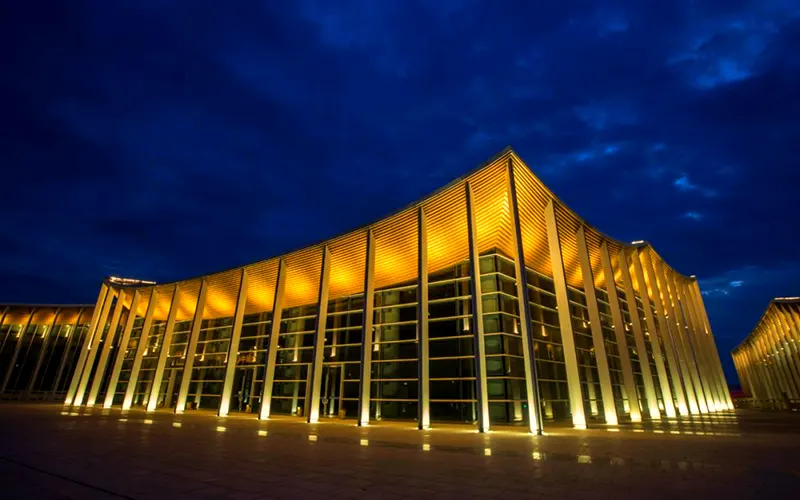
Haute efficacité et économies d'énergie
Les néons flexibles à LED utilisent la technologie LED, qui se caractérise par une excellente efficacité énergétique. Par rapport aux néons traditionnels, les néons flexibles à LED permettent d'économiser jusqu'à 50% d'électricité, voire davantage.
Les néons traditionnels génèrent une quantité importante de chaleur lorsqu'ils fonctionnent, ce qui entraîne un gaspillage d'électricité et peut nuire aux effets lumineux. Les lampes LED, en revanche, ne dégagent que peu de chaleur, ce qui leur permet de fonctionner de manière stable pendant de longues périodes sans que leurs performances ne se dégradent en raison d'une augmentation de la température.
Longue durée de vie des tubes néon à LED
Un autre avantage majeur des néons LED flexibles réside dans leur durée de vie exceptionnellement longue. La durée de vie moyenne d'un néon LED peut atteindre 50 000 heures, voire plus, ce qui dépasse de loin celle des néons traditionnels.
Contrairement aux néons traditionnels, qui nécessitent généralement un remplacement ou un entretien annuel, la longue durée de vie des néons LED flexibles se traduit par une fréquence d'entretien réduite et des coûts de remplacement moindres.
Pour les installations situées en altitude ou dans des endroits difficiles d'accès (tels que les façades d'immeubles commerciaux, l'éclairage des ponts, etc.), la longue durée de vie des néons LED flexibles évite aux architectes et aux propriétaires de se soucier d'un entretien fréquent, ce qui permet de réduire les coûts de main-d'œuvre et de temps.
Flexibilité et adaptabilité
L'une des principales caractéristiques des néons flexibles à LED réside dans leur grande souplesse et leur grande adaptabilité. Contrairement aux néons traditionnels, dont la forme est fixe, les néons flexibles à LED peuvent être courbés et personnalisés selon n'importe quelle exigence, s'adaptant ainsi parfaitement à diverses formes architecturales et aménagements d'espace.
Qu'il s'agisse d'une façade complexe ou d'un espace intérieur courbe et irrégulier, les néons LED flexibles permettent d'obtenir un effet lumineux homogène et sans rupture.
Les designers peuvent créer des effets d'ombre et de lumière uniques en s'inspirant de la structure singulière du bâtiment. De plus, la mise en place des néons LED flexibles est très simple, ce qui permet un agencement flexible en fonction des exigences de conception et évite d'avoir recours aux supports complexes ou aux structures rigides nécessaires lors de l'installation des néons traditionnels.
Durabilité
Les guirlandes lumineuses LED flexibles offrent une durabilité exceptionnelle, notamment en termes de résistance aux intempéries, grâce à l'utilisation de matériaux en silicone de haute qualité.
Elles résistent aux agressions environnementales, notamment à la pluie, à la poussière, aux températures extrêmes et aux rayons UV. Que ce soit sous une pluie torrentielle, une chaleur extrême ou des températures glaciales, les néons LED flexibles conservent des performances stables et s'adaptent aux défis posés par divers environnements extérieurs.
Cela en fait un choix idéal pour l'éclairage extérieur, particulièrement adapté à l'éclairage paysager urbain, aux façades de bâtiments, aux décorations de rue et à l'éclairage des ponts, ainsi qu'à d'autres situations où les installations sont exposées à l'environnement naturel pendant de longues périodes.
Respect de l'environnement
Les bandes lumineuses LED flexibles offrent non seulement des avantages en termes d'économies d'énergie, mais répondent également aux exigences en matière de protection de l'environnement. Contrairement aux néons traditionnels qui contiennent des substances nocives telles que le mercure, les bandes lumineuses LED flexibles ne contiennent pas de produits chimiques toxiques et ne polluent pas l'environnement.
De plus, la faible consommation d'énergie des lampes LED permet de réduire la consommation d'électricité, ce qui diminue encore davantage leur empreinte carbone. Pour les projets de construction axés sur la construction écologique et le développement durable, les néons flexibles à LED constituent sans aucun doute un choix idéal.
Large choix de couleurs et d'effets
Les bandes lumineuses LED flexibles offrent une grande variété de couleurs et d'effets lumineux. Qu'il s'agisse d'un éclairage monochrome, de variations de couleurs RVB ou d'effets lumineux dynamiques, tout cela peut être réalisé grâce à un système de commande simple.
Les architectes peuvent concevoir des effets d'éclairage variés en fonction des différents besoins, tels que des dégradés, des clignotements et des effets de mouvement, créant ainsi des effets visuels uniques.
De plus, la température de couleur des bandes LED flexibles de type néon peut être réglée en fonction des besoins du projet, offrant ainsi différents choix allant de la lumière blanche chaude à la lumière blanche froide.
Comment installer correctement des guirlandes lumineuses LED flexibles ?
Lors de la conception et de l'installation de bandes lumineuses LED flexibles de type néon, une conception adéquate et une installation soignée permettent non seulement d'optimiser l'effet lumineux, mais aussi de prolonger considérablement la durée de vie de la bande lumineuse. Voici quelques conseils clés en matière de conception et d'installation pour vous aider à tirer le meilleur parti des fonctionnalités et de l'effet de vos bandes lumineuses LED flexibles de type néon.
Détermination de la direction d'émission de la lumière
L'angle d'émission lumineuse des néons flexibles à LED est un facteur clé à prendre en compte lors de la conception. En fonction des contraintes d'installation, les néons flexibles à LED présentent deux directions principales d'émission lumineuse : l'émission vers le haut et l'émission latérale.
En choisissant judicieusement la direction d'émission de la lumière, il est possible d'ajuster efficacement l'effet visuel des néons flexibles à LED afin de mieux répondre aux exigences esthétiques du projet.
Bandes LED « Top-view » : les bandes LED « Top-view » émettent la lumière par le haut, ce qui permet d’obtenir un éclairage homogène. Ce type de conception est généralement utilisé pour l’éclairage de grandes surfaces, telles que les longs couloirs, les plafonds ou les façades de bâtiments. L'avantage des bandes à éclairage par le haut réside dans leur lumière homogène et sans taches, ce qui les rend idéales pour l'éclairage général et permet de créer un effet lumineux ample et doux.
Bandes LED à éclairage latéral : les bandes LED à éclairage latéral diffusent la lumière sur le côté, ce qui les rend idéales pour l'éclairage de détails ou l'éclairage décoratif. Les bandes à éclairage latéral sont particulièrement adaptées aux aménagements nécessitant de mettre en valeur les contours, les bords et les courbes, tels que les murs intérieurs, les rebords de fenêtre ou les bords de meubles. Elles apportent une touche de sophistication et d'art à un espace, en créant des effets de lumière et d'ombre doux et fluides.
Détermination du rayon de courbure des bandes LED
L'un des principaux avantages des néons flexibles à LED réside dans leur excellente souplesse, qui leur permet de s'adapter à diverses formes architecturales complexes et à différents agencements spatiaux.
Il convient toutefois d'accorder une attention particulière au choix du rayon de courbure lors de l'installation. Chaque bande LED flexible de type néon présente un rayon de courbure minimal recommandé, qui ne doit pas être dépassé lors de l'installation.
Utilisation de profilés en aluminium et de clips de fixation
Afin d'améliorer les performances de dissipation thermique des guirlandes lumineuses LED flexibles et de garantir un fonctionnement stable à long terme, il convient d'envisager l'utilisation de profilés en aluminium ou de clips de fixation spécifiques lors de l'installation.
Ces accessoires permettent non seulement d'embellir les bandes lumineuses LED flexibles, mais aussi de prolonger leur durée de vie. En particulier dans les environnements d'installation exigeants ou complexes, l'utilisation d'outils d'installation adaptés garantit une installation à la fois plus esthétique et plus fiable.
- Profilés en aluminium : les profilés en aluminium favorisent efficacement la dissipation de la chaleur et réduisent la température, tout en améliorant la stabilité globale de la bande lumineuse. En particulier en cas d'utilisation prolongée ou avec des bandes lumineuses à forte puissance, les profilés en aluminium empêchent la bande lumineuse d'être endommagée par la surchauffe, tout en offrant une protection physique supplémentaire pour éviter tout dommage.
- Clips de fixation : l'utilisation de clips de fixation spécifiques permet de fixer solidement la bande lumineuse à l'emplacement souhaité, ce qui évite tout glissement ou desserrage. Conçus pour être pratiques et faciles à installer, ces clips réduisent efficacement la pression exercée sur la bande lumineuse elle-même et empêchent toute courbure ou déformation due à une utilisation prolongée.
Choisir l'alimentation électrique et le système de commande adaptés
Les performances des bandes lumineuses LED flexibles de type néon ne dépendent pas seulement de la bande elle-même, mais aussi d'une alimentation électrique et d'un système de commande adaptés. En fonction de vos besoins spécifiques, vous devrez choisir l'alimentation électrique et le système de commande appropriés afin d'optimiser les fonctionnalités et l'effet de la bande lumineuse.
- Choix de l'alimentation électrique : les bandes lumineuses LED flexibles sont généralement disponibles en tensions de 12 V et 24 V. Le choix d'une alimentation électrique adaptée garantit le bon fonctionnement de la bande lumineuse et évite toute perte de luminosité ou tout dommage causé par une instabilité de tension. Les alimentations 24 V conviennent aux installations sur de longues distances et permettent de mieux maintenir une luminosité constante, tandis que les alimentations 12 V sont adaptées à une utilisation sur de courtes distances.
- Système de commande : Le système de commande des néons flexibles à LED influe directement sur la qualité des effets lumineux. Parmi les systèmes de commande courants, on trouve la commande monochrome, la commande RVB et la commande RVBW. Le choix d'un système de commande adapté permet d'obtenir différents effets lumineux, tels que des dégradés, des clignotements et des changements de couleur.
Comment choisir le néon LED adapté à l'éclairage architectural ?
Lorsqu'on choisit des produits d'éclairage architectural à LED de type « néon flexible », il faut privilégier leur qualité et les caractéristiques techniques. Le prix est secondaire, mais ces deux aspects sont importants.
Exigences en matière de tension et de puissance
Choisissez entre des bandes LED flexibles de 12 V et 24 V en fonction de vos besoins réels. Le 24 V convient généralement à l'éclairage de grandes surfaces, tandis que le 12 V est adapté aux applications de plus petite envergure.
Flux lumineux et décroissance lumineuse
Évaluez la luminosité réelle du produit (en lumens) ainsi que son taux de perte de luminosité après une utilisation à long terme. Les produits de haute qualité conservent mieux leur luminosité initiale.
Indice d'imperméabilité
Nos tubes néon sont tous certifiés IP67 pour leur étanchéité, et des modèles IP68 sont également disponibles. Ils sont spécialement conçus pour l'éclairage sous-marin et de piscine.
Cohérence des couleurs
Veillez à la “ tolérance chromatique ” du produit (ellipse de MacAdam), en vous assurant que la teinte de la lumière blanche ou de certaines couleurs est parfaitement homogène d'un lot à l'autre et sur toute la longueur des bandes LED, afin d'éviter toute différence de couleur.
Certifications et garanties
Assurez-vous que le produit a obtenu les certifications internationales telles que CE et RoHS, ce qui garantit qu'il respecte les normes en matière de sécurité et de protection de l'environnement. Veillez également à vérifier la durée de la garantie offerte par le fournisseur.
Comment choisir le bon fournisseur de néons LED flexibles ?
Vous vous demandez sans doute comment trouver un fournisseur fiable et digne de confiance de bandes LED néon flexibles. Le choix d'un fournisseur fiable est donc essentiel pour garantir la réussite de votre projet. Vous pouvez vous référer aux informations suivantes :
- Qualité des produits et certification
S'assurer que les produits fournis par le fournisseur sont conformes aux normes internationales et disposent des certifications requises, telles que les marquages CE et RoHS.
- Service après-vente et assistance
Le professionnalisme et la fiabilité transparaissent lors des échanges ; l'obtention d'échantillons à des fins de test garantit en outre un entretien adéquat et un soutien technique après l'achèvement du projet.
- Témoignages de clients et études de cas
Consultez les avis des autres clients ainsi que les exemples de réussite du fournisseur afin d'évaluer les performances de ses produits dans le cadre de projets concrets.
Résumé
Les bandes lumineuses LED de type néon flexibles destinées à l'éclairage architectural font le lien entre l'architecture, la lumière et l'art. Qu'il s'agisse de souligner les contours majestueux des bâtiments, de créer un éclairage tamisé et discret à l'intérieur ou de produire des variations de couleurs dynamiques et complexes, les bandes lumineuses LED de type néon flexibles permettent de concrétiser n'importe quelle vision en matière d'éclairage.
Pour plus d'informations ruban LED néon de haute qualité, s'il vous plaît nous contacter.
FAQ
Nous vous recommandons de commencer par effectuer des mesures précises. Indiquez sur les plans tous les parcours devant être éclairés par des tubes néon LED, puis ajoutez une marge de 5-10% après avoir additionné les longueurs. Pour les projets complexes, il est préférable de faire appel à un concepteur d'éclairage professionnel.
Pour l'éclairage architectural extérieur, nous recommandons vivement d'opter pour des produits présentant au minimum un indice de protection IP67. Tous nos tubes néon sont étanches (IP67 ou supérieur).
Non, chaque produit présente un rayon de courbure minimal. Ce rayon doit être strictement respecté lors de la conception et de l'installation ; dans le cas contraire, le circuit imprimé interne et les puces LED risquent d'être endommagés, ce qui pourrait entraîner un dysfonctionnement du produit.
Oui, la couleur et la luminosité des bandes LED flexibles de type néon peuvent généralement être réglées à l'aide d'un contrôleur. Les bandes monochromes diffusent une lumière d'une couleur fixe, tandis que les bandes RVB et RVBW permettent d'obtenir une grande variété de couleurs et d'effets dynamiques, ce qui les rend idéales pour les éclairages créatifs et la création d'ambiances.
Les néons flexibles à LED ont une très longue durée de vie et sont adaptés à une utilisation à long terme. Comparés aux néons traditionnels, ils nécessitent moins d'entretien.