
LED strip lights are widely used in home lighting decoration, commercial lighting, building facades, and stage visual design. This is due in part to the variety of color temperatures available for LED strips, including single-color, dual-color, and RGB options. However, to truly achieve the ideal lighting effect with these light strips, simply choosing high-quality strips is not enough—a suitable LED controller is equally crucial. The LED controller is the “commander” of the entire lighting system. It determines the brightness, color, and changing patterns of the light strip, and whether it can work in conjunction with smart systems. Next, we will explain in detail what an LED controller is, the differences between controller types, the factors you must consider before selection, and how to find the best control solution for your LED strips.
What is an LED Controller?
An LED controller is an electronic device that receives instructions and sends signals to LED light strips to control their brightness, color (for colored light strips), and dynamic effects. You can think of it as the “brain” and “nerve center” of the light strip.
For LED strip lights, whether single-color, dual-color, or RGB, a controller is required. Controllers come in various types; you simply need to find a compatible one.
Core functions: It’s more than just a switch. Advanced controllers can achieve precise dimming (stepless adjustment from 0% to 100%), color adjustment (free selection from millions of colors), and preset various dynamic modes (such as gradient, flashing, and jumping).
Working principle: The controller controls the brightness and color mixing ratio of the LEDs by changing the output current and voltage, or by using PWM (pulse width modulation) technology to switch the circuit at a very high frequency, thereby achieving a wide range of lighting effects.
How to Choose the Right LED Strip Controller?
When choosing an LED strip controller, you need to clearly define your needs and the color temperature of your LED strips. Therefore, before browsing any products, please clarify the following three points, as they are fundamental to ensuring compatibility and meeting your requirements.
LED Strip Type: Single Color, RGB, or RGBW?
- Single Color LED Strip: Emits only one color of light (e.g., warm white, cool white). It typically has only two wires (positive and negative).
- Dual Color LED Strip: Can emit two colors of light (e.g., warm white and cool white). It typically has three wires.
- RGB LED Strip: Can change various colors. It contains three chips: red, green, and blue, therefore typically has four wires (common anode + red + green + blue).
- RGBW LED Strip: Adds a separate pure white chip to the RGB design, providing a purer, softer white light. It typically has five wires.
Another crucial choice is that the controller must be strictly matched to the type and number of interfaces of the LED strip.
LED Strip Voltage and Total Power
Our LED strips are commonly available in DC 12V and 24V. You must confirm the voltage value on the strip’s packaging or label and select a matching controller.
Power calculation is crucial, as a single controller cannot handle an unlimited number of meters of LED strip. This is key to preventing controller overload. First, check the strip’s power per meter (e.g., 14.4W per meter), then multiply by the total length used. For example, a 5-meter strip at 14.4W per meter has a total power of 5m × 14.4W/m = 72W.
It’s important to note that the rated output power of the selected controller must exceed the total power of the strip. A 20%-30% margin is recommended. In the example above, a controller with a power rating of at least 90W should be selected.
Define your control needs
Controllers come in various types, and their control methods and functions differ. Do you simply need a remote control to turn things on and off and switch modes?
Or would you prefer remote control via a mobile app, allowing you to operate the device even when you’re not home? Do you need integration with smart home systems like Apple HomeKit or Amazon Alexa for voice control or scene-based interaction?
What are the Common Types of LED Strip LED Controllers?
Based on market demand, communication protocols and control methods, mainstream LED controllers can be categorized as follows. You can choose according to your budget and desired functionality:
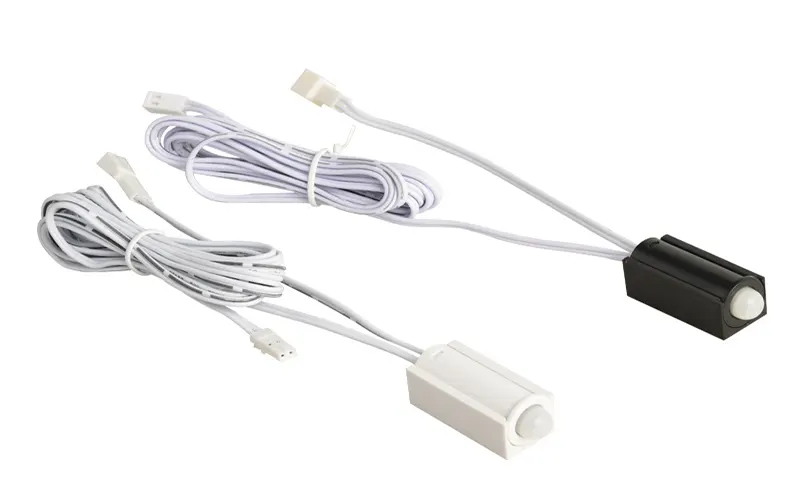
IR (Infrared) Controller
This LED controller is the most affordable, requiring the remote control to be directly aimed at the receiver. It has a short effective range (<5 meters) and poor penetration.
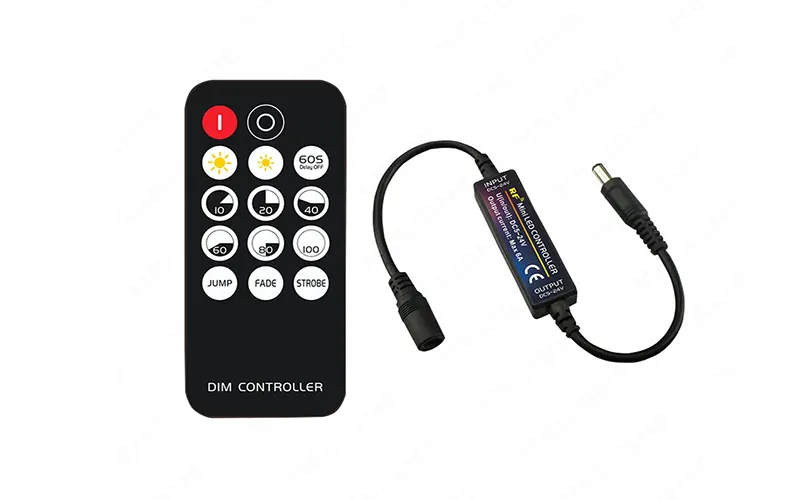
RF Remote Control Controller
Uses radio waves to transmit signals, allowing for wall-penetrating control without aiming, and boasts a relatively long range (typically up to 20 meters). It strikes a balance between functionality and cost.
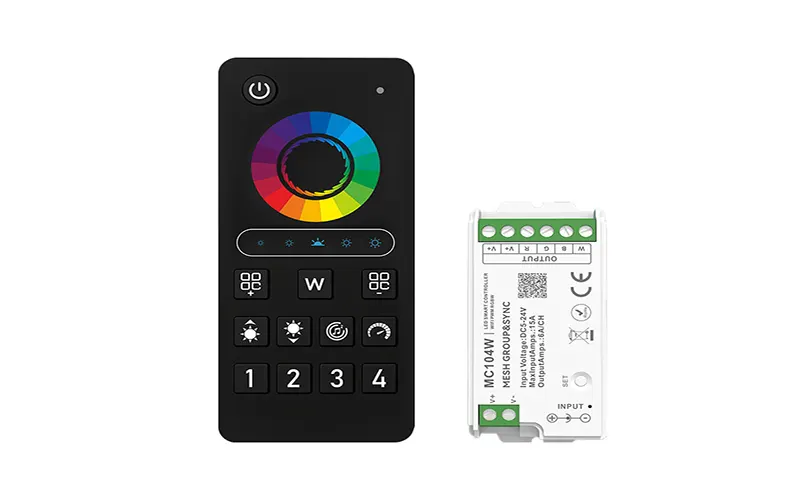
Wi-Fi Controller
Connects directly to your home Wi-Fi network. Enables global remote control via a mobile app and easily integrates into mainstream smart home ecosystems (supports voice control). The most powerful feature, making it the top choice for smart homes.
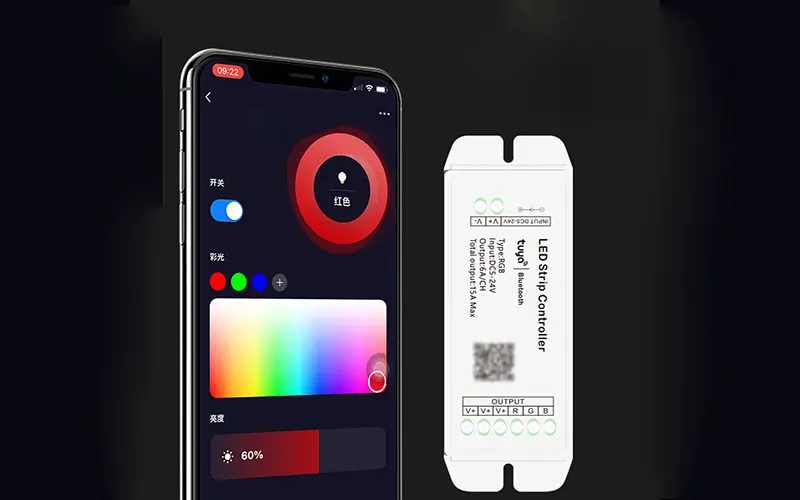
Bluetooth Controller
Controls directly via Bluetooth connection to a mobile phone, with a relatively short range (typically within 10 meters). Suitable for convenient control in personal spaces (such as bedrooms and studies), requiring no network connection.
DMX Controller
A standard protocol used in professional fields (such as stages, building facades, and commercial showrooms), capable of controlling massive numbers of light strips and achieving extremely precise and complex programming effects, but setup is relatively complex.
DALI and 1-10V Controllers
High stability, suitable for commercial and office lighting systems; Requires specialized wiring and driver support.
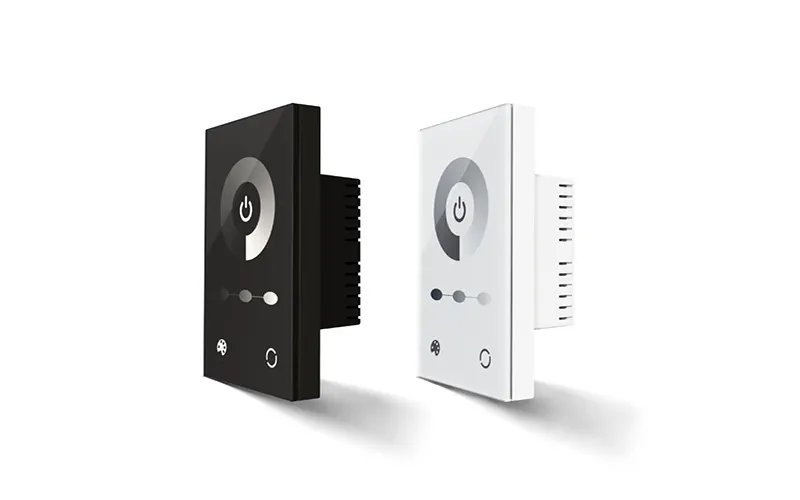
Wall Panel LED Controllers
Directly mounted on the wall, providing an intuitive touch or button interface, suitable as a main switch for a fixed area.
How to Choose the Right LED Controller Based on LED Strip Type?
When selecting a controller, pay close attention to the color temperature of the LED strip. The controller’s “number of channels” and “functions” must strictly match the LED strip type. When purchasing, carefully check that the controller’s “number of output channels” perfectly matches your LED strip type. More details, pls read What is the Use of DMX512 Controller?
- Monochrome LED Strip: Requires only one output channel controller. Usually the simplest and cheapest.
- CCT Adjustable Color Temperature LED Strip: Requires two output channels (cool white channel + warm white channel). The controller must have color temperature adjustment functionality.
- RGB LED Strip: Requires three output channels (R, G, B). The controller must have color mixing capabilities.
- RGBW/RGBWW LED Strip: Requires four or five output channels (RGB + one or two white channels). This is the most complex type and requires a powerful multi-channel controller.
Key Factors to Consider When Choosing an LED Controller
Besides considering LED strip controller compatibility and power, the following factors determine your user experience:
- Power Capacity: Ensure the controller’s rated power > total LED strip power × 1.2. Overloading is the main cause of controller damage and safety hazards.
- Control Distance and Signal Stability: Evaluate based on the installation location. For large spaces or environments with many walls, prioritize RF or Wi-Fi controllers.
- Dimming Smoothness: Professional controllers use high-quality PWM technology to provide deep, smooth, and flicker-free dimming effects. Low-quality controllers may exhibit noticeable stepping or flickering during dimming (a common defect in many low-end controllers).
- Stability and Heat Dissipation: Especially for high-power controllers, good heat dissipation design (such as an aluminum alloy casing) is essential. Excessive heat is a major cause of shortened controller lifespan and malfunctions.
- Maximum Connection Length: Confirm that the controller can reliably control your total LED strip length without using signal amplifiers to avoid signal attenuation.
Conclusion
To select the right LED controller for your LED strip, first identify your strip type (monochrome/RGB/RGBW) and calculate the total power; second, determine the control protocol based on your control habits (remote control/app/voice); Finally, rigorously verify key parameters such as power, voltage, and smart ecosystem compatibility. If you require a high-quality LED controller, please contact us.
FAQs
We do not recommend this. If it’s an RGBW LED strip, you should choose an RGBW LED empty box controller. While an RGB controller might be able to light the strip, you won’t be able to use the dedicated white channel.
Yes, but two basic conditions must be met. All LED strips must be of the same type (e.g., all RGB or all RGBW). Secondly, the total power cannot exceed the controller’s rated power.
Absolutely. If the LED strip lights are installed outdoors or in a humid environment, a controller with an IP65 or higher waterproof rating is essential to prevent water ingress, short circuits, or corrosion damage. Ensuring the stable operation of the system is crucial.
Absolutely not. The output voltage of the controller (driver) must perfectly match the operating voltage of the LED strip (12V for 12V, 24V for 24V). A voltage mismatch will cause the LED strip to either be too dim or burn out completely.
We recommend replacing the controller directly, as the repair cost may be higher than the cost of a new one. Therefore, it’s essential to purchase a high-quality LED controller.