
In the innovation of smart lighting, digital LED strips have transcended simple decoration, becoming a canvas for creating dynamic visual art. Whether creating dazzling architectural facades or constructing immersive stage effects, the core lies in precisely issuing commands to each individual LED. This is where two mainstream lighting “languages”—SPI and DMX512 digital LED strip—become crucial. However, many users are confused by these two technologies: what are the differences between them? Which one should I choose for my project?
This article will delve into the working principles, characteristics, and differences of these two SPI and DMX512 digital LED strip lighting systems to help you make the right choice for your project.
What is an SPI Digital LED Strip?
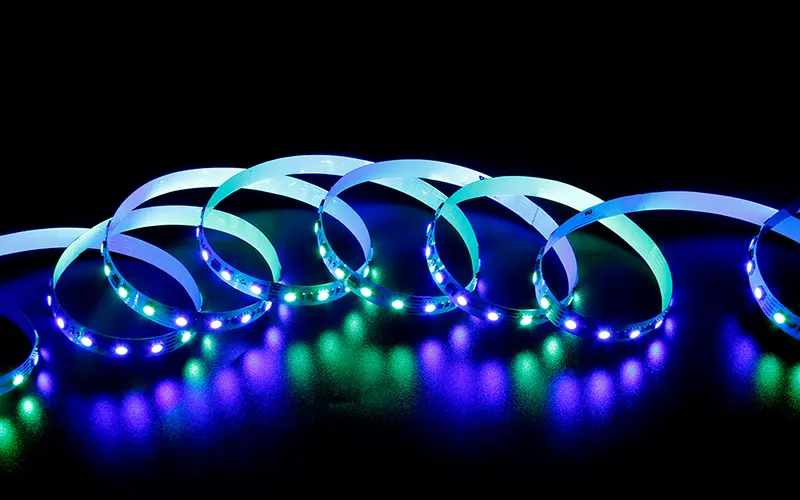
An SPI (Serial Peripheral Interface) LED strip is a programmable LED strip that uses a serial communication protocol. Each LED integrates an independent control chip, such as the WS2812B or SK6812. These chips can receive digital signals and independently control the color and brightness of each LED.
The working principle of an SPI strip is to transmit signals through one or two data lines. As an example, the WS2812 B uses a single-wire transmission protocol, where data is sent sequentially from the first LED to the next, producing a “cascaded” effect.
Each LED chip receives its own data packet and forwards the remaining data to the next LED. This design allows the strip to achieve complex pixel-level animation effects, with each LED being an independently controllable “pixel.”
Common SPI chip types include WS2811/WS2812B (most common, single-wire transmission) and SK6812 (supports RGBW colours). These LED strips typically operate at 5V or 12V, making them suitable for small to medium-sized projects. Of course, 24V SPILED strips are also available and are commonly used in small to medium-sized projects.
What is a DMX512 Digital LED Strip?
A DMX512 digital LED strip is a lighting product based on the DMX512 protocol. The DMX512 (Digital Multiplex, 512) protocol was originally designed for stage and theater lighting, aiming to provide powerful, standardized control capabilities.
The DMX512 protocol uses differential signal transmission and a standard XLR interface (usually 3-pin or 5-pin) for connection. One DMX512 universe can control 512 channels, each channel can transmit values from 0 to 255.
For RGB LED strips, each segment typically requires 3 channels (one each for red, green, and blue), therefore one universe can control a maximum of approximately 170 RGB strip units. DMX512 RGBW is also currently available.
A significant feature of DMX512 is its stability and anti-interference capability. The differential signal transmission method allows the signal to remain stable over long distances (up to 300 meters) and is less susceptible to electromagnetic interference.
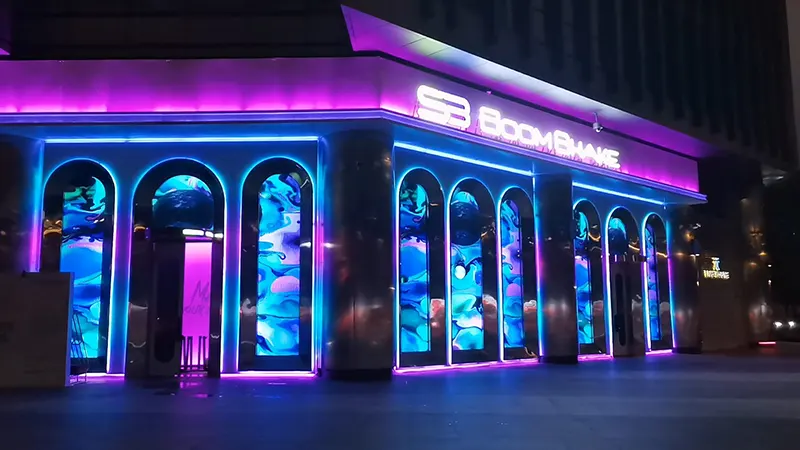
This makes the DMX512 the preferred choice for large-scale stage, architectural lighting, and outdoor installations. Furthermore, DMX512 equipment offers excellent interoperability, typically allowing seamless compatibility between devices from different brands.
Key Differences Between SPI and DMX512 Digital LED Strips
We can comprehensively compare and analyze SPI and DMX512 LED strips to help you choose the most suitable lighting system.
Control Method Differences
SPI uses master-slave control, where the controller directly sends data to each LED, and the data is transmitted in a cascading manner. DMX512 uses broadcast control, where the controller sends signals to all devices simultaneously, and each device retrieves the corresponding data based on its address code.
Signal Transmission Technology
SPI uses single-ended signal transmission, resulting in relatively weak anti-interference capabilities. It is suitable for short-distance transmission (ideally within 5 meters, with a maximum of 30 meters). DMX512 uses the differential signal RS485 standard, offering strong anti-interference capabilities and a transmission distance of up to 300 meters, and even further with repeaters.
Control Precision
Each LED in an SPI LED strip is an independently controllable pixel, enabling sophisticated animation effects and image display. DMX512 typically controls LEDs in segments, with one address code controlling one segment (e.g., 1 meter or 50cm). While its precision is relatively lower, it’s sufficient for large-area lighting.
Interface Standards
SPI LED strips typically use a simple 3-pin interface (power+, signal, ground), offering flexible but less standardized connections. The DMX512 uses a standard XLR interface, providing reliable connections and industry-wide compatibility.
Cost Factors
SPI LED strips and their controllers are relatively inexpensive, making them suitable for projects with limited budgets. DMX512 systems, due to their use of professional standards and components, are more expensive but offer greater reliability and scalability. Ultimately, the choice depends on your budget.
Comparison of the Advantages and Disadvantages of SPI and DMX512 Digital LED Strip
Now that we’ve learned about the differences between SPI and DMX512 LED Strips, let’s analyze their advantages and disadvantages. Let’s take a comprehensive look at them.
Advantages of SPI LED Strips:
- Strong pixel-level control capabilities, with each LED independently controllable, suitable for creating intricate animations and display effects.
- Low cost and low entry barrier, suitable for DIY enthusiasts and small projects.
- Simple control system, easily implemented using open-source hardware such as Arduino and Raspberry Pi.
- Flexible programming with numerous open-source libraries and sample code available for reference. Particularly suitable for creative projects and interactive development.
Disadvantages of SPI Digital LED strips:
- Some SPI LED chips have resume functionality, but a front-end failure will affect all subsequent LEDs.
- Transmission distance is limited, signal attenuation is rapid, and long-distance transmission requires a signal amplifier.
- Interference resistance is weak, and signal anomalies may occur in complex electromagnetic environments. Refresh rate and data transmission speed are limited, leading to latency in large-scale applications. There is no unified industry standard, and different chip protocols are incompatible.
Advantages of DMX512 Digital LED strips:
- Industry-standard protocol, excellent device compatibility, interoperable across different brands.
- Stable and reliable signal transmission, suitable for long-distance lighting projects.
- Professional-grade reliability, suitable for commercial performances and permanent installations.
- Highly scalable, capable of managing thousands of channels through a multi-universe controller.
- Easy maintenance, simple fault diagnosis and equipment replacement.
Disadvantages of DMX512:
Relatively low control precision, typically controlled in segments.
High system cost; requires purchasing a controller, decoder, and specialized cabling.
Relatively complex configuration; requires setting address codes and understanding channel allocation.
Too professional and expensive for small projects.
Difficult to achieve pixel animation effects; requires professional programming skills.
When to Choose SPI LED Or DMX512 Digital LED Strip?
When to Choose SPI LED Strip
If your lighting project meets the following criteria, you may prioritize the use of SPI LED strips:
- The project is relatively small in scale, with a total LED strip length of less than 20 meters.
- Complex pixel animations or image display effects are required.
- The budget is limited, and cost control is a priority.
- Project involves a temporary installation or is of a DIY nature.
- User wishes to utilize open-source hardware platforms, such as Arduino.
- The installation is located indoors, within a relatively simple electromagnetic environment.
When to Choose DMX LED Strip
If your current lighting project involves any of the following scenarios, you should opt for DMX512 LED strips:
- Large-scale projects involving long-distance transmission (exceeding 30 meters)
- Professional commercial or performance projects with high reliability requirements
- Requires integration with existing DMX lighting systems
- Permanent installations requiring long-term stable operation
- Used in outdoor environments or complex electromagnetic settings
- Requires centralized management of a large number of lighting fixtures
Conclusion
SPI LED strips and DMX512 digital LED strip represent two different concepts in digital lighting control. You need to make the right choice based on your lighting project. Choosing the right technology not only affects the successful implementation of the project but also impacts later maintenance costs and system upgrade capabilities. If you are looking for high-quality SPI or DMX512 digital LED strips, please contact us for more product information and solutions.
FAQs
If the SPI LED strip signal transmission distance is insufficient, it is recommended to install a signal amplifier every 5-10 meters. For DMX512 systems, the transmission distance can be extended by adding a signal repeater. Using higher quality cables and reducing the number of connectors can also effectively improve signal quality.
SPI typically requires a specific microcontroller and corresponding programming knowledge; DMX512 requires a dedicated console or software with a DMX interface. It mainly depends on your project needs; DMX512 controllers are more expensive.
No, DMX512 strips require a DMX decoder to convert the digital signal into a control signal that the strip can recognize. After decoding, the strip can be connected to the LED power supply for stable control.
For home decoration, cabinet lighting, or DIY projects, SPI LED strips are more suitable because they are inexpensive and easier to install and connect.
We do not recommend this, although it is possible in professional lighting projects. This is because some control systems support DMX-SPI converters, enabling DMX signals to be output to SPI light bars for cross-protocol synchronous control. However, this method requires professional setup and debugging, and is best performed by a technician.