
If your LED light strips are to be paired with LED profiles, the choice of the LED cover is of paramount importance. Imagine this scenario: you have meticulously selected a high-quality LED strip, only to find—after installing it with eager anticipation. That the light is glaring and the individual LED beads are clearly visible, completely ruining the elegant ambiance you had envisioned. The root cause of this issue almost certainly lies with the LED diffuser channel. It serves not merely as a “hiding place” for the light strip. But as the very soul that brings a professional-grade lighting effect to life. Whether you are a home DIY enthusiast or a professional contractor.
This article will guide you through a systematic approach to selecting the LED diffuser channel. That best suits the specific requirements of your project.
What is an LED Diffuser Channel?
An LED diffuser channel is typically manufactured from PC (polycarbonate) material. It is an essential accessory when installing LED light strips. It serves a dual purpose: providing the necessary structural support for the LED strips while diffusing light through a cover. Thereby enhancing light uniformity and preventing hotspots and shadows.
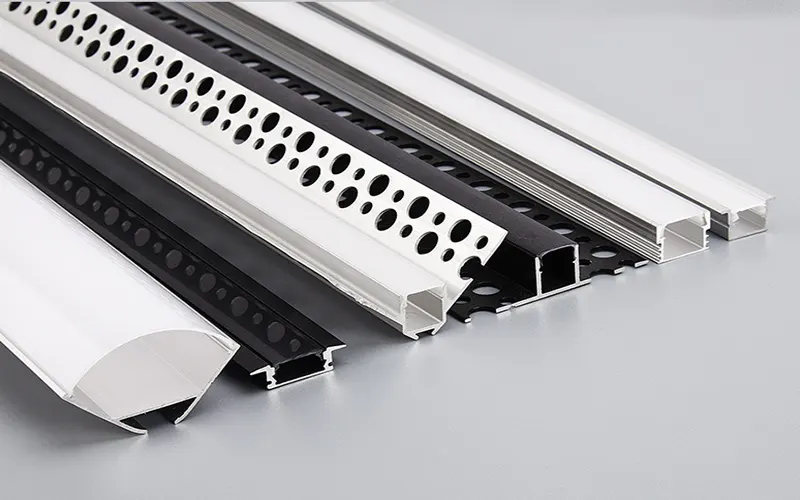
Function of the Diffuser Cover: Diffuser covers are typically available in various finishes. Such as clear, opal (milky white), or frosted—which help to evenly disperse the light emitted by the LED strips. This results in a softer, more diffused lighting effect, effectively eliminating the visual distraction caused by individual point sources.
The design of LED diffuser channels is typically highly flexible. They can accommodate LED light strips of various shapes and sizes, and offer a multitude of mounting options to meet the diverse requirements of different projects.
How to Choose the Right LED Diffuser Channel?
Selecting the appropriate LED diffuser channel is a complex undertaking—a systems engineering task that requires a comprehensive assessment across multiple dimensions. Including optical performance, structural design, and the installation environment. The following are the core factors you must prioritize when making your decision.
Materials: The Foundation
Regarding material durability, high-quality PC material boasts an impact strength more than 20 times that of acrylic. It can withstand significant mechanical stress without cracking, making it ideal for public spaces or locations prone to physical impact. When making a selection, it is recommended to request the material’s UL94 flame retardancy certificate (which should meet V0 or V2 standards) as well as its light transmittance test report.
LED Diffuser Transmittance
The material type and processing technique of a diffuser cover directly determine the final lighting effect and product lifespan. Different transmittance levels are suited to different application scenarios:
Transparent Dimming (90%-95% Light Transmittance)
Made of highly transparent PC or PMMA material, allowing light to pass through with almost no loss. This type of diffuser is suitable for scenarios requiring maximum luminous flux. Such as warehouse lighting, workbench lighting, and plant grow lights.

Advantages include highest brightness and optimal energy efficiency. However, the disadvantages are also significant: almost no diffusion effect. The point light source of the LED beads is clearly visible, causing glare. Recommended for use in concealed installations or at a distance from the viewer’s eyes.
Diffusion Cover (Transmittance: 70%–80%)
Achieved through internal surface frosting or the incorporation of light-diffusing agents,. This LED cover ensures excellent light uniformity while maintaining a high level of light transmittance. It is the most widely used type on the market, striking an optimal balance between brightness and visual comfort.

Ideal for applications such as under-cabinet lighting, display case illumination. And indirect lighting—scenarios where both brightness and uniformity are essential requirements. The light produced is soft yet bright; while the individual LED beads may be faintly discernible, the light remains entirely glare-free. This makes it the premier choice for both residential and commercial spaces.
Opal White Diffuser (Transmittance: 60%–65%)
The milky white diffuser utilizes a high-concentration diffusing agent or a multi-layer composite structure to achieve exceptional light diffusion. Once diffused, the light creates a completely uniform luminous surface where no individual LED beads are visible; the visual effect resembles a continuous line of light.

This option is ideal for settings with extremely high standards for visual quality. Such as hotel lobbies, high-end retail stores, and restaurants—where it serves to enhance the ambient lighting. Although light transmittance is slightly reduced, this can be compensated for by utilizing higher-wattage LED strips. This type of diffuser creates a truly premium lighting effect.
Black Diffuser (Transmittance: 30%–35%)
The black cover is manufactured using tinted PC material or a specialized coating process, offering a unique decorative aesthetic. When the lights are off, it presents a dark, sleek appearance that blends seamlessly with dark-themed interior designs. When the lights are on, light shines through to create a mysterious and atmospheric effect.
It is ideally suited for settings requiring distinctive visual effects—such as bars, nightclubs, and art installations. Due to its low light transmittance, high-power LED strips are required to achieve sufficient brightness.

How to Properly Install LED Covers? Maintenance Details
The critical factor in installation is dimensional compatibility: the width of the LED strip. The internal channel dimensions of the aluminum profile. And the specifications of the cover must align precisely; otherwise, issues such as an inability to fit, looseness, or even deformation may arise.
1: Before installation, ensure the interior of the profile is thoroughly cleaned to prevent dust and debris from becoming trapped inside;
2: Simultaneously, verify that the LED strip is securely fastened and that the wiring is laid out neatly; failure to do so may result in bulging or uneven light distribution after installation.
3: Installation methods vary slightly depending on the structural design of the cover. A common method is the snap-in installation: begin by aligning the cover with the mounting groove at one end, then apply even pressure until it snaps firmly into place. Exercise caution during this process to avoid applying excessive force, which could lead to cracking.
4: For slide-in style covers, slowly slide the cover in from one side, and then secure it using end caps. This method offers greater stability and results in a neater, more streamlined appearance.
5: Covers without snap-in mechanisms (typically press-fit types) require special attention regarding fixation. If necessary, utilize adhesive strips or auxiliary fastening structures; otherwise, the cover may easily loosen or detach.
Over time, if the LED cover exhibits significant yellowing, reduced light transmittance, cracking. If there is severe surface abrasion, it must be replaced promptly. Failure to do so will not only compromise the lighting performance but also diminish the overall aesthetic quality of the fixture. In summary, while the installation of LED covers is not inherently complex. The key to success lies in meticulous preparation during the initial stage and proper maintenance thereafter, thereby ensuring long-term stability and optimal lighting results.
In summary
Through this systematic explanation LED diffuser channel, you should now have a comprehensive understanding of everything from basic concepts to key selection points. You need to consider factors such as materials, shape, installation method, size, and brand. By understanding the characteristics and applications of different types of diffuser channels, you can choose the most suitable LED diffuser channel for your project.
If you are looking for the right LED diffuser channel for your lighting project. Please visit our website to view our selection of aluminum profiles and diffuser options. Our professional team will help you choose the most suitable product to ensure your project is perfectly implemented!
FAQs
It’s not absolutely mandatory, but we recommend it. Direct installation without an LED diffuser channel can result in glare (visible LED chips). Damage to the LED strip, unsightly installation, and poor heat dissipation.
Many LED diffuser channels are designed for indoor use, and few are designed for outdoor applications. If you plan to use it outdoors, be sure to choose waterproof and weather-resistant materials to ensure that the LED strip and diffuser channel function properly in various weather conditions.
Yes, absolutely. Most LED diffuser channels are designed to be simple. Usually, you just need to fix the channel in the designated position and embed the LED strip into the channel.
This is a problem caused by long-term use; poor quality diffusers will exhibit this phenomenon. It may be due to inferior PC or PMMA materials lacking UV-resistant additives, causing them to age under ultraviolet radiation.