
When choosing LED strip lights, have you ever encountered the term CRI? Have you been confused by the “CRI” parameter in the specifications? You might have heard that 95 CRI is a top standard, but you might wonder, “Is 95 CRI suitable for LED strip lights? Do I really need it?”
In fact, for most applications, a CRI of 90 or higher is a good standard. It’s an indispensable choice in scenarios where ultimate color accuracy is required. The core value of 95 CRI LED strip lights lies in their ability to reproduce the truest and most vibrant colors of objects. This article will take you on a deep dive into 95 CRI, revealing its importance and guiding you to make the smartest choice in the crowded market.
What is CRI? Why Is It So Important for Lighting?
CRI, or Color Rendering Index, is an objective measure of a light source’s ability to reproduce the colors of objects accurately. Its rating ranges from 0 to 100, with higher values indicating that the colors seen under that light source are closer to the colors seen under a standard reference light source (such as natural daylight).
If the CRI is below 80, the colors of objects we see will not be true to life. This can affect our judgment and perception. High CRI light sources, on the other hand, are like ultra-high-definition, colorless glass, allowing you to perceive the truest details of colors.

How does CRI affect our visual experience?
The importance of CRI lies not only in aesthetics but also in its functional and psychological impact. It affects our judgment of objects and can distort our color perception.
- Accuracy: In kitchens, workshops, or art exhibitions, accurately identifying colors is a functional requirement.
- Depth and Dimension: High CRI enhances the color saturation and contrast of details in objects, making them appear more layered and three-dimensional.
- Comfort: High-quality light sources are easier on the eyes, reducing visual fatigue after prolonged work.
Why Choose 95 CRI LED Strip Lights?
Currently, 95 CRI LED strip lights are widely advertised on the market, mainly for use in demanding and specialized applications. This also means you are choosing top-of-the-line color performance in the civilian lighting field. Its advantages are specific and impressive:
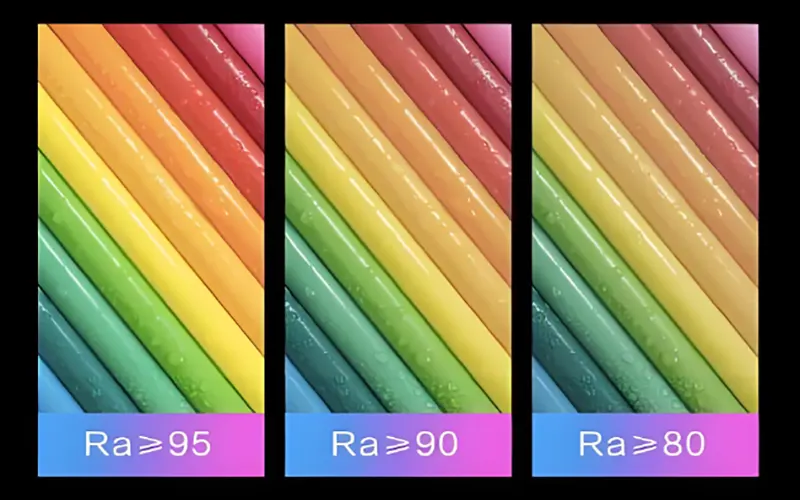
Exceptional Color Fidelity
This is the core feature of the CRI95 LED strip. It accurately reproduces the saturation, hue, and brightness of every color. Whether it’s the brushstrokes of an artwork or the vibrant colors of fruits and vegetables, everything appears lifelike.
Enhancing Visual Comfort and Quality
Due to accurate color reproduction, the human eye feels very comfortable and natural when viewing objects under this lighting, greatly reducing fatigue from prolonged exposure to artificial light. At the same time, the high color rendering index (CRI 95) itself enhances the overall quality and sophistication of the space.
Enhancing Product Appeal
In a retail environment, accurate color rendering can significantly enhance product appeal. A piece of clothing or jewelry will appear more attractive under 95 CRI lighting, directly boosting sales conversion.
Meeting professional and precise needs
For photographers, painters, video bloggers, or designers, 95 CRI LED strip lights can provide stable and reliable ambient or fill lighting, ensuring accurate colors in their footage and significantly reducing the amount of post-production color correction needed.
When is the Best Time to Choose 95 CRI LED Strip Lights?
While 95 CRI is excellent, it’s not necessary for all situations. Because 95 CRI LED strips are quite expensive, your budget should be spent wisely. Here are scenarios where using 95 CRI LED strip lights is highly recommended:
Commercial Lighting
- High-end Retail Stores: Clothing stores, jewelry stores, cosmetics counters, art galleries – color accuracy directly impacts sales.
- Food and Beverage Display: Restaurant tables, bar counters, bakery display cases – making food and drinks look more delicious and appealing.
- Museums and Art Galleries: Faithfully reproducing the original colors of exhibits is a fundamental requirement.
Professional Work and Creative Spaces
- Photography and Video Studios: For use as ambient or fill lighting, the lights should ideally have a CRI of 95 or higher.
- Home Offices/Studios: Work areas for designers, painters, craftspeople, and others who have demanding requirements for color accuracy.
High-End Home Lighting
- Kitchen Countertops and Under-Cabinet Lighting: Ensures accurate color rendering of ingredients, making it easier to judge freshness and making the cooking process more enjoyable.
- Bathroom Vanity Mirror Lighting: Provides accurate front lighting, ensuring correct makeup colors and avoiding embarrassing color discrepancies after leaving the house.
- Lighting for Home Artwork and Collectibles: Precisely illuminates paintings and sculptures, showcasing their artistic value.
95 CRI, and the R9 Value is Equally Important
For truly professional lighting applications, focusing solely on the overall CRI score is insufficient. You must also consider a crucial sub-index: the R9 value, which is equally important.
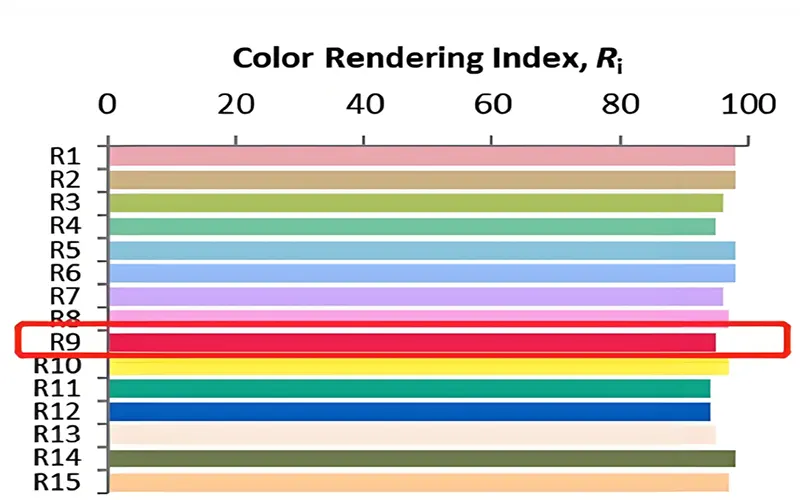
- The Importance of the R9 Value: The calculation of the crucial red color rendering index (CRI) is primarily based on eight colors with lower saturation (R1-R8), but R9 is a special measurement indicator of the ability to render saturated red.
- R9 is critical: Red is very important in human vision, affecting the perceived healthiness of skin tone, the attractiveness of food (meat, fruits), and the color representation of many works of art and decorations.
Some light fixtures have a high overall CRI (e.g., 90), but a very low R9 value, or even a negative one. This can cause red objects to appear dull and lifeless. For high-quality lighting, we not only want the overall CRI to be above 90, but also hope that the R9 value reaches above 50, ideally around 90.
How to Know If the LED Strip Lights You Purchased Truly Have a CRI of 95?
If you absolutely require CRI95 LED strip lights, you must confirm this with the supplier in advance. Request a test report before shipment to ensure your LED strip lights are indeed CRI95.
- Check the product specifications: CRI95 LED strip lights are considered a special series; the CRI value should be clearly indicated in the product datasheet (e.g., CRI ≥ 95, CRI > 95).
- Request third-party test reports: For large-volume purchases or critical projects, you can request IES files or spectral test reports from an authoritative laboratory from the supplier. This is the most reliable proof.
- Pay attention to the R9 index: As mentioned earlier, check if the product also specifies a high R9 value (recommended >90).
- Trust professional brands: Choose brands with a good reputation in the high-end commercial lighting field; their technology and quality control are more reliable.
It’s also important to note that achieving 95 CRI requires higher-quality phosphors and more precise manufacturing processes, making the cost significantly higher than ordinary LED strips. If the price is unusually low, the claimed 95 CRI is highly suspect.
Conclusion
With a CRI of 95, this LED strip light is not only suitable for general lighting but is also the ultimate solution for those seeking exceptional visual experience and professional-grade color rendering. If your lighting project requires a CRI of 95, visit Neonledstrip today to explore our high color rendering index LED strip light series.
FAQs
No, they are two completely different concepts: Color temperature indicates the “warmth” or “coolness” of light.
CRI (Color Rendering Index) indicates a light source’s ability to accurately reproduce the true colors of objects. However, the two are closely related, and both are very important.
They are ideal for environments requiring accurate color rendering, such as high-end retail displays, photography studios, art galleries, beauty salons, and brand showrooms. These are considered specialized applications due to their slightly higher cost.
Yes, there will definitely be problems if you use two different CRI LED strips in the same space. In the same room or adjacent areas, if you use a 95 CRI LED strip (for example, on a kitchen countertop) and an 80 CRI LED strip (for example, in a ceiling cove), you will notice a significant inconsistency in color and differences in color quality.
There is no such claim. LED strip lights with a CRI of 95 or higher require high-quality components. Manufacturers use higher-quality LED chips and phosphor materials, along with strict quality control standards. Therefore, choosing a 95 CRI product from a reputable brand often guarantees a longer lifespan.