
In the LED strip market, you’ll inevitably encounter the numbers SMD3528, SMD2835, and SMD5050, referring to different types of LED chips. Many purchasing decision-makers are confused by these numbers: what do they actually represent? Besides size differences, how do they differ in terms of brightness, power consumption, and cost? This article will provide a detailed comparison guide, thoroughly analyzing the core differences between SMD3528 vs SMD2835 vs SMD5050, ultimately helping you determine which one is the best choice for your commercial project.
Basic Parameter Comparison of SMD3528 VS SMD2835 VS SMD5050
SMD stands for “Surface Mounted Device,” referring to the LED packaging form that is directly soldered onto the LED strip’s PCB board.
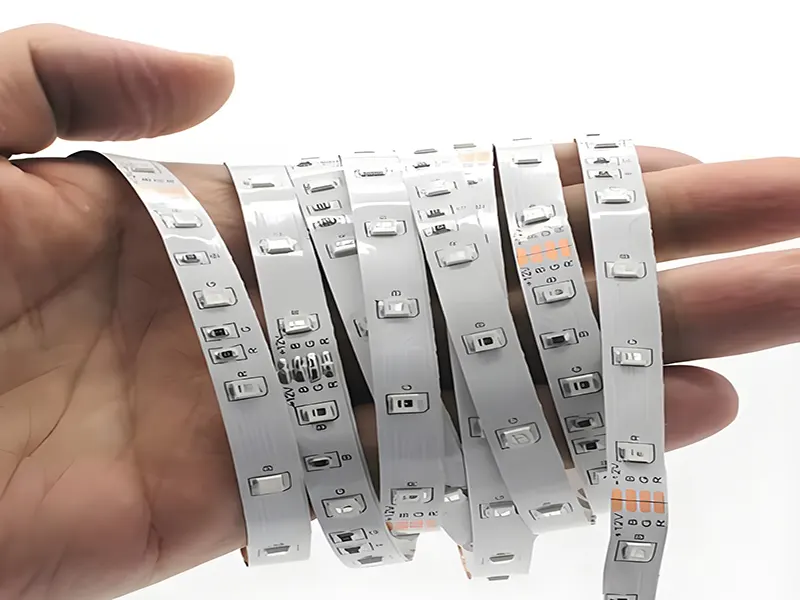
The numbers represent the chip dimensions (in millimeters): for example, SMD3528 means 3.5mm × 2.8mm, while SMD5050 means 5.0mm × 5.0mm.
| SMD Name | SMD3528 | SMD2835 | SMD5050 |
| Size | 3.5×2.8 mm | 2.8×3.5 mm | 5.0×5.0 mm |
| Wattage/per LED | 0.06W | 0.2W | 0.24W |
| Brightness per LED | 6–8 lm | 20–24 lm | 18–22 lm |
| Illumination angle | 120° | 120°-140° | 120° |
| Features | Energy-saving, low brightness | High luminous efficiency, low heat High brightness | Multicolor (RGB) |
In summary, the SMD2835 generally offers better luminous efficiency than the 3528, while the SMD5050, due to its larger size allowing for three chips, supports RGB color mixing and is therefore more commonly used in stage, ambient, or decorative lighting.
SMD3528 VS SMD2835 VS SMD5050
Let’s comprehensively analyze these LED chips from different aspects: SMD3528 vs SMD2835 vs SMD5050. This will help you make a better choice.
Brightness and Lighting Effects Differences
- SMD2835 performs best in monochrome lighting applications. Its high brightness and excellent luminous efficiency make it the preferred choice for commercial spaces requiring ample illumination. It is now also available for RGB color lighting.
- Although SMD3528 has lower brightness, it excels in providing soft and uniform light, making it suitable for decorative and indirect lighting. It is available in high-density LED strips, with the SMD3528 240 LEDs per meter being the best-selling.
- SMD5050’s brightness in monochrome mode is between the two, but when RGB color lighting is required, the 5050 is the only practical option.
Heat Generation and Dissipation Performance
Heat generation is a critical issue for LED strip lights, directly affecting lifespan and safety. SMD3528, due to its low power consumption, generates the least heat and requires almost no additional heat dissipation measures. Although SMD2835 has higher power, its improved heat dissipation structure ensures good thermal management.
However, SMD5050, with its built-in three chips, generates relatively more heat. For prolonged use, especially in enclosed spaces or high-density installations, an LED aluminum heat sink is necessary.
Color Performance and Application Flexibility
For commercial applications requiring dynamic color changes—such as ambient lighting in bars and restaurants, and retail store window displays—the RGB functionality of SMD5050 is irreplaceable.
Through a controller, 16 million color variations and various dynamic effects can be achieved. Currently, SMD2835 is also available in color options, and at a more favorable price.
In contrast, 3528 and 2835 are usually single-color (white, warm white, cool white, or a single color). While some color adjustment can be achieved by mixing different color temperature LED strips, their flexibility is far less than that of 5050.
What Other Types of SMD LED Strip Lights are Available?
Besides SMD3528, 2835, and 5050, there are several other high-performance SMD models available on the market. You can also learn about:
SMD5630/5730: High power and extremely high brightness, commonly used in main lighting fixtures and commercial high-brightness LED strips. However, these are quite expensive, and the demand for them has decreased.
SMD3014: Small size and dense arrangement, suitable for high-density LED strip designs, providing a smoother light output.
SMD2216/2110: These are even smaller LEDs, primarily used to achieve high-density LED strips, providing a softer, grain-free lighting effect in limited spaces. They are commonly found in high-end decorative lighting and TV backlighting.
High-Density vs. Large-Sized LED Chips: Which is Better?
High-density LED strips typically feature more LED chips on the same size strip (such as SMD2835). Their core advantage lies in the uniformity and continuity of the light. In close-range viewing environments (such as mirror cabinets or jewelry display cases), high-density LED strips effectively eliminate unpleasant light spots, providing a superior visual experience.
Larger LED chips (such as SMD5050 or SMD5730) offer the advantage of higher absolute luminous flux output per LED. They are more suitable for lighting applications requiring “impact” and “penetration,” such as illuminating a deeper space or serving as the main light source for dynamic color lighting.
In conclusion: If you seek soft, seamless lighting where the light source is invisible, choose high-density LED strips; if you prioritize absolute brightness or vibrant color effects, choose larger LED chips.
Which SMD LED Model is Best Suited for Commercial Use? SMD3528 VS SMD2835 VS SMD5050
Currently, the most widely used LED strip lights on the market are COB LED strips and SMD2835 series LED strips. We have briefly analyzed the use of LED strip lights in the following scenarios:
Retail Stores and Supermarkets
I recommend SMD2835, 120 LEDs per meter, color temperature 4000-5000K, CRI≥90. High brightness and excellent energy efficiency reduce operating costs, and good color rendering accurately displays product colors, stimulating purchasing desire. For high-end product display areas such as jewelry and cosmetics, a high color rendering version with CRI≥90 should be selected.
Restaurants and Cafes
Recommended: SMD3528 or SMD2835, color temperature 2700-3000K warm white light. Soft and warm lighting creates a comfortable dining atmosphere. For creating different atmospheres at different times (e.g., evening bar mode), SMD5050 RGB LED strips can be used locally as supplementary ambient lighting, with scene switching achieved through a dimming system.
Office Spaces
Recommended: SMD2835, color temperature 5000K-6000K neutral white, CRI ≥80. This color temperature is close to natural light, reducing eye strain and improving work efficiency. A dimming system is recommended to automatically adjust brightness based on natural light intensity, further saving energy.
Hotels and Entertainment Venues
We recommend the SMD5050 RGB+W (color plus white light) solution. The color and brightness can be changed according to different times and event needs, creating a dynamic atmosphere. SMD2835 can be used for basic lighting in public areas such as lobbies and corridors, while 5050 can be used locally to create distinctive effects.
Outdoor Signage and Architectural Lighting
We recommend SMD5050 or SMD5630 LEDs with at least IP67 protection rating. High-power LEDs provide sufficient brightness to overcome ambient light, and RGB functionality allows for brand color display and dynamic effects, enhancing visual impact.
What Factors Should Be Considered When Choosing SMD LED Strip Lights?
Once we confirm the SMD model, we also need to consider the following important details, as they directly determine the final effect and lifespan of the LED strip. Pls check How to Choose the Perfect Flexible LED Strip Lights?
Voltage and Length
Common low-voltage LED strip lights are available in 12V and 24V. The chosen voltage also relates to the length of the strip. 24V LED strips experience less voltage drop over long distances, making them suitable for long-distance wiring in large commercial spaces.
Color Rendering Index (CRI)
This is a crucial indicator for commercial retail, but many people overlook it. CRI measures a light source’s ability to accurately reproduce the true colors of objects. It is recommended to choose products with a CRI > 80. For places with high color requirements, such as clothing stores, art galleries, and restaurants, a CRI > 90 (RA90) is essential.
IP Protection Rating
This defines the dust and water resistance of the LED strip. IP20 is suitable for dry indoor environments (such as ceilings and cabinets); IP65 can be used in places that may come into contact with moisture, such as kitchens and bathrooms; if used outdoors, IP67/IP68 must be selected.
LED Strip Color (Color Temperature)
Choose according to the commercial environment. 3000K warm yellow light creates a cozy atmosphere (restaurants, hotels), 4000K-5000K neutral natural light promotes concentration (offices, clinics), and 6000K cool white light provides bright and clear illumination (production workshops, garages).
Power Supply and Driver Quality
The quality of the driver directly affects the lifespan and stability of the LED strip. Using high-quality constant voltage (or constant current) drivers with overload protection and voltage stabilization is fundamental to ensuring long-term reliability in commercial applications.
Conclusion
Choosing the right SMD3528 VS SMD2835 VS SMD5050 LED strip is a crucial decision in commercial lighting design, directly impacting lighting effects, costs, and customer experience. SMD 3528 is suitable for decorative applications with limited budgets and a need for soft, even lighting; SMD 2835 is the preferred choice for many applications due to its superior brightness, energy efficiency, and cost-effectiveness, making it the best option for most commercial lighting projects; SMD 5050 is irreplaceable in scenarios requiring color changes and atmosphere creation.
If you also need high-quality LED strips, we offer a full range of SMD 2835 and 5050 high-CRI LED strip products, as well as IP67 neon strips.
FAQ
There’s actually not much difference; the main difference lies in the continuity and uniformity of the light. The high-density version has more LED chips soldered per unit length, making the light appear as a continuous strip with almost no visible individual light points.
For commercial lighting environments such as office buildings, shopping malls, and hotels, SMD2835 LED strip lights are the ideal choice. This is because 2835 LED chips are now available in various forms.
Actually, they are all energy-efficient, but the SMD 2835 LED strip achieves the best balance between brightness and power consumption. It’s brighter than the SMD 3528 and more energy-efficient than the SMD 5050, making it ideal for large-area commercial lighting or projects requiring long operating times.
We believe 24V is a better choice for commercial use. The main difference lies in voltage drop. Over longer wiring distances, 24V LED strips maintain more uniform brightness, preventing noticeable dimming at the end of the strip.
SMD 5050 is the standard choice for RGB color-changing LED strips. This is because the 5050 chip is larger in size, allowing it to encapsulate three independent chips for red (R), green (G), and blue (B), enabling full-color mixing and color-changing effects. However, there are now more options available, such as 2835 RGB and 4040 RGB.