
Users who install LED light strips often have the same question: What should I do if the LED strip lights falling off after installation? This not only affects the appearance but also damages the light strip, reduces luminous efficiency, and can even create safety hazards. Next, we will explain in detail the reasons why LED light strips may fall off, quick repair methods, and how to fundamentally prevent this problem, ensuring your light strip can emit light stably for a long time.
Why do LED Strip Lights Fall Off?
If you encounter an LED light strip that has fallen off, first observe the cause. Is it a problem with the 3M adhesive on the LED strip itself, or is the surface on which it was applied poorly?
Therefore, understanding the cause of the LED light strip detachment is crucial before attempting repair. Incorrectly blaming the light strip itself may lead to a failed repair attempt. Three common causes of detachment:
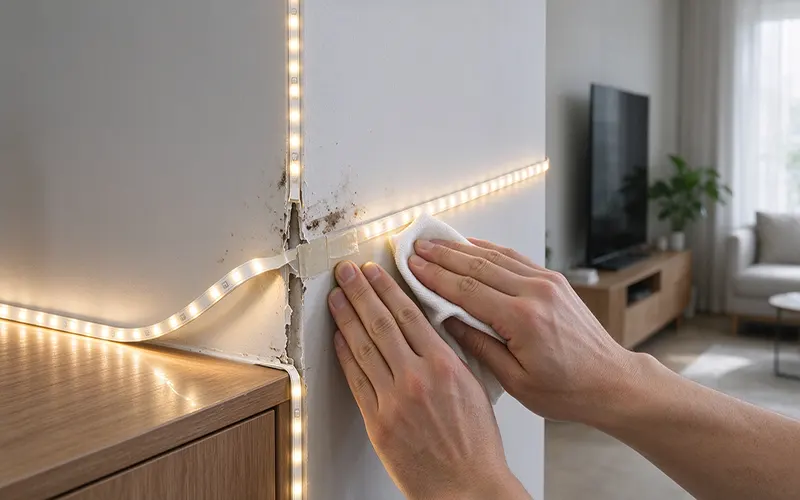
Poor Quality or Aging of Original Adhesive
Many entry-level LED strips come with adhesive (often low-cost double-sided tape) that has limited strength, especially in the following situations:
- Weight Limitation: For heavier waterproof (IP65 and above) strips, ordinary adhesive may not be able to support their weight.
- Temperature Sensitivity: Sustained high temperatures (such as near heaters or heat generated by the strip itself during prolonged operation) can cause the adhesive to soften and lose its stickiness.
Improper Surface Preparation
This is the most common and easily avoided reason. If the installation surface is not clean, even the best adhesive will not work:
- Dust and Oil: Tiny particles, oil stains, or fingerprints remaining on the surface will form a protective layer.
- Rough or Porous Surfaces: Rough concrete or untreated wood will reduce the adhesive’s contact area.
Environmental Factors (Thermal Expansion and Contraction, Humidity)
The LED strip will slightly expand and contract depending on the season and operating conditions. Fluctuations in temperature, depending on the installation environment, will also have an impact.
- Temperature Variation: If the LED strip is installed outdoors or near windows where there are large temperature differences, repeated thermal expansion and contraction will continuously “tear” the adhesive.
- High Humidity: Humid environments such as kitchens and bathrooms will accelerate the decomposition and failure of the adhesive.
Emergency Simple Repair for Falling LED Strip Lights
When an LED strip suddenly detaches, you may not want to immediately reinstall the entire strip. In this case, you can try the following temporary repair methods:
Using transparent tape or masking tape for fixation
This is the simplest temporary solution, suitable for inconspicuous locations.
- Advantages: Quick, low cost
- Disadvantages: Prone to aging, unsightly.
Double-sided tape re-application
Choose high-adhesion 3M VHB tape or foam double-sided tape, remove the old adhesive, and re-apply.
- Advantages: Enhanced adhesion
- Disadvantages: Suitable for short-term reinforcement, not suitable for high-temperature environments
Small fixing clips for auxiliary support
If the detached part is relatively long, it can be temporarily secured to the light trough or edge using plastic clips or cable ties.
Note: The above methods are only for short-term use. A thorough and permanent repair is recommended afterward.
How to Repair a Falling LED Strip Lights? Long-Term Solutions
For long-term stability of detached LED strips, a more durable adhesive method or structural support is necessary. More information, pls read How to Keep LED Strip Lights from Falling?
Choose the right LED strip adhesive
Compared to ordinary double-sided tape, LED-specific adhesives or high-strength adhesives are better able to withstand temperature and humidity changes. When choosing, also consider the material of the surface where it will be applied. Pls check How to Choose High-Quality LED Strip Adhesive Tape (Complete
- 3M VHB Industrial Grade Tape: Strong adhesion, suitable for smooth surfaces.
- Neutral Silicone Sealant/Industrial Adhesive: Suitable for damp environments such as kitchens and bathrooms, or rough surfaces. However, ensure the use of neutral silicone adhesive to avoid corrosion of the LED strip’s circuit board by acidic adhesives.
- Hot Melt Adhesive: Suitable for non-metallic surfaces, but temperature must be controlled to avoid damaging the LED strip.
Using physical fixing clips and mounting tracks
Physical fixing is the most reliable way to prevent detachment. It is very suitable for indoor installations, but the integrity of the wall surface must also be considered.
- Plastic or metal mounting clips: Can be screwed into walls or light troughs for a secure and reliable installation.
- Aluminum profile mounting tracks: Not only prevent light strips from sagging, but also improve heat dissipation and aesthetics.
- Transparent PVC cover tracks: Suitable for indoor decorative light strips, providing dust and impact protection.
Tips for Preventing LED Strip Lights from Falling Off
To prevent LED strip lights from falling off, we can take preventative measures at the source. When installing LED strip lights in the future, please follow these principles: More, Why Are the LED Strip Lights Not Sticking?
- Choose high-quality LED strips: High-quality LED strips typically use 3M or equivalent VHB adhesive.
- Plan for heat dissipation in advance: Ensure sufficient space for heat dissipation at the installation location. If installed in a confined space or requiring prolonged operation, use aluminum profiles to aid heat dissipation.
- Avoid direct sunlight or humid environments: For kitchen, outdoor, or bathroom use, waterproof and heat-resistant LED strips are recommended.
- Consider thermal expansion and contraction: When attaching the LED strip, do not stretch it too tightly. Leave slight “margin” at corners or ends to accommodate temperature changes.
Conclusion
LED strip lights falling is a common household problem, so a proper, permanent repair solution is essential. Whether upgrading to high-strength VHB tape or using physical clamps and mounting tracks, you can ensure your strip lights stay securely and aesthetically pleasing in any position.
Want to avoid frequent strip light detachment? Choose from our high-adhesion LED strip light series and aluminum alloy mounting tracks to easily create a stable and beautiful lighting space.
FAQs
That’s most likely due to insufficient surface preparation. If the mounting surface isn’t thoroughly cleaned of old adhesive residue, dust, grease, or fingerprints, any new adhesive won’t form a lasting bond.
It’s not recommended to rely solely on adhesives. Rough, porous surfaces (such as brick walls or untreated wood) significantly reduce the adhesive’s contact area, inevitably leading to detachment.
Yes, because they are heavier. Also, waterproof light strips are usually covered with a silicone or PVC layer, which has a slippery surface, making them less adhesive with regular double-sided tape. Use waterproof tape or physical clips during installation to enhance the fixation.
Long-term use is not recommended. Transparent tape is prone to aging, discoloration, and even peeling off under prolonged lighting and high temperatures. For long-term stability, it’s best to use 3M industrial adhesive or mounting clamps.