
When you begin planning your lighting project, especially when purchasing LED strips, you’ll soon face a fundamental and crucial choice: low-voltage LED strips (such as 12V/24V) or high-voltage LED strips (such as 110V/220V)? This isn’t just a voltage difference; it involves safety, installation difficulty, lighting distance, luminous efficacy, and overall cost. Next, we’ll analyze the differences between low-voltage vs. high-voltage LED strip lights to help you make the most suitable choice.
What are Low-voltage and High-voltage LED Strip Lights?
The fundamental difference between “low-voltage” and “high-voltage” LED light strips lies in their power supply voltage. This voltage difference directly affects the light strip’s safety, installation method, cutting length, application scenarios, and brightness stability. And cost structure.From an industry standard perspective:
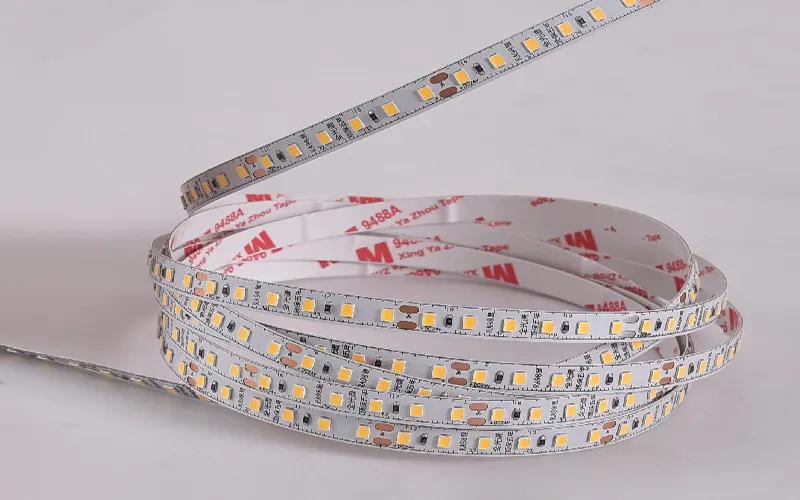
- Low-voltage LED light strips: typically operate at DC 12V or DC 24V.
- High-voltage LED light strips: typically operate at AC 110V or AC 220V and can be directly connected to AC mains power.
Although both are used for linear lighting, they differ fundamentally in structural design, driving methods, and application environments.
Low-voltage LED light strips
Low-voltage LED strip lights refer to flexible LED strip lights operating at 12V or 24V. They cannot be directly connected to AC power and must be converted from 110V/220V AC. To safe low-voltage DC before use.
Common models include the SMD5050/2835/COB/5050 series, etc. Low-voltage strip lights have a relatively simple structure. 12V/24V is a safe voltage; even if a person accidentally touches the exposed copper points. There is generally no risk of electric shock, making them very suitable for home use.
- Advantages of low-voltage LED strip lights: flexible cutting, customizable lengths, stable brightness, etc.
- Disadvantages of low-voltage LED strip lights: 12V typically provides power for 3-5 meters from one end. While 24V typically provides power for 8-15 meters from one end. A power conversion is always required, and voltage drops can occur over long distances, causing the latter half of the strip to dim.
What is a High-voltage LED Strip Light?
A high-voltage LED light strip is a light strip that can be directly connected to AC 110V or AC 220V mains power without an external transformer. The internal structure of a high-voltage light strip is more complex than that of a low-voltage one, involving high-voltage LED chips connected in series and a rectifier module (AC to DC), etc., thus enabling continuous power supply for tens or even hundreds of meters.
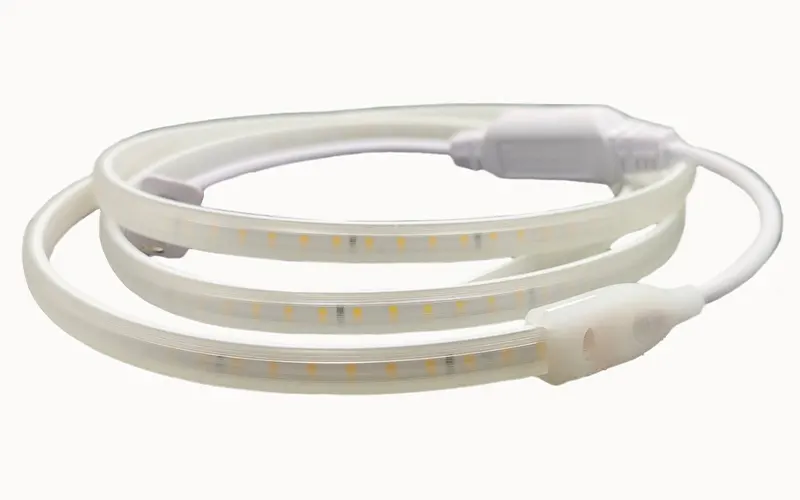
- Advantages of high-voltage LED light strips: The biggest advantage is ultra-long continuous power supply; a single strip can provide uninterrupted illumination for 30, 50, or even 100 meters. Furthermore, no additional power adapter is required.
- Disadvantages of high-voltage LED light strips: If the insulation of 110V/220V light strips breaks, there is a risk of electric shock; they cannot be freely cut, and it is best not to cut them. They are also prone to flickering.
Comparison: Low-Voltage vs. High-Voltage LED Strip Lights
To help lighting users better understand and choose, we’ve comprehensively compared low-voltage and high-voltage LED strips in seven aspects. You can choose based on your lighting project needs.
1. Safety Comparison
The biggest advantage of low-voltage LED strip lights is their high safety. Operating only at 12V or 24V, even touching them will not cause electric shock. They are ideal for home, cabinet, children’s rooms, or wet areas.
In contrast, high-voltage LED strip lights use 110V or 220V power. While they provide stronger driving force, they must be strictly waterproofed and insulated, otherwise there is a risk of electric shock. Therefore, they are not suitable for indoor use and are more suitable for outdoor, commercial signage, or high-altitude lighting projects.
2. Ease of Installation
High-voltage LED strips can be directly connected to AC power without an additional power adapter, making installation significantly simpler.
Low-voltage strips, on the other hand, require a power driver, and voltage drop limits the connection distance. Typically requiring separate power every 5-10 meters. However, they offer greater flexibility in cutting and can be customized.
3. Maximum Length of a Single Connection
Low-voltage LED strips have lower voltage, making them prone to voltage drops, thus limiting the length of each strip. Furthermore, the recommended connection length for 12V and 24V is 5-10 meters.
In contrast, high-voltage LED strips can easily achieve continuous installations of 50 meters or even 100 meters, almost unaffected by voltage decay. Making them ideal for large-scale outdoor projects.
4. Brightness and Luminous Efficacy
Brightness is not solely determined by voltage, but rather by chip efficiency and current density. High-voltage LED strips typically use high-quality LED chips, resulting in more stable luminous efficacy and color temperature consistency.
However, due to the larger drive current, high-voltage LED strips may experience slight brightness fluctuations or flickering over long distances.
5. Raw Material Costs
Low-voltage LED strips require an additional power adapter and controller, resulting in slightly higher initial costs, but they offer more precise control and stable output.
High-voltage LED strips have lower initial investment (no power adapter required), but consume slightly more power over extended periods, and repairs are more difficult if damaged.
6. Product Flexibility
Low-voltage LED strips can be freely cut and spliced according to design, making them suitable for corner, arc. Or creative lighting designs, offering great installation flexibility.
High-voltage LED strips typically have fewer cutting points (per 1 or 2 meters) and require resealing of waterproof connectors, thus offering less flexibility.
7. Lifespan and Maintenance
Under high-quality conditions, low-voltage LED strips typically have a lifespan of 30,000–50,000 hours or more. Because of their lower operating current and lower temperature.
High-voltage LED strips, on the other hand, are prone to light decay or drive loss due to their higher driving voltage. And larger current surges during long-term use.
Low Voltage vs. High Voltage LED Strip Lights: Which One Do You Need?
After the comparison above, I think everyone has a better understanding. You can make your final choice based on the core needs of your project: More details, pls read Just Look At These Eight Points When Buying LED Strips
Choosing low-voltage LED strip lights (12V/24V):
Safety is the primary consideration: Installation in children’s rooms, cabinets, bathrooms, or near outdoor water features. Single strip length should not exceed 15-20 meters, requiring flicker-free operation, high color rendering index, or complex RGBIC effects.
Choosing high-voltage LED light strips (110V/220V):
For applications requiring ultra-long-distance lighting: A single strip needs to exceed 20 meters in length (e.g., building exteriors, large corridors). Also, for applications with lower requirements for light intensity and brightness, used solely for outdoor decorative lighting.
Conclusion
By comparing low-voltage vs. high-voltage LED strip lights, we find that low-voltage LED strips excel in safety, flexibility, and luminous efficacy; while high-voltage LED strips offer significant advantages in long-distance lighting and ease of installation.
If you are looking for high-quality low-voltage LED strips, please visit our website Neonledstrip.com.
FAQs
High-voltage LED strip lights are typically 110V or 220V, and can be directly connected to AC mains power. They are suitable for large-area installations outdoors or in commercial locations. The advantage is that no external power supply is required, but it is essential to ensure the use of safe, waterproof drivers and connectors to enhance safety.
At the same brightness, both consume similar amounts of power. However, low-voltage LED strips have higher energy efficiency and more uniform light distribution. High-voltage LED strips, on the other hand, have lower current loss over long distances, making them more suitable for large-area applications, primarily outdoors.
No. Low-voltage LED strips require a transformer or driver to convert the voltage from AC 220V to DC 12V or 24V; otherwise, the LEDs will burn out or the circuitry will be damaged.
This is because the higher the voltage, the lower the current. High-voltage light strips (such as 220V) draw significantly less current than low-voltage light strips (such as 12V) when transmitting the same power. Therefore, high-voltage light strips can more effectively overcome resistance and transmit light evenly over a longer distance.
Low-voltage LED light strips (12V or 24V) are strongly recommended. Because the kitchen environment may contain moisture and grease, and the installation location is easily accessible, the extra-low voltage (SELV) characteristic of low-voltage light strips is crucial. Additionally, consider whether to use waterproof LED strips.