
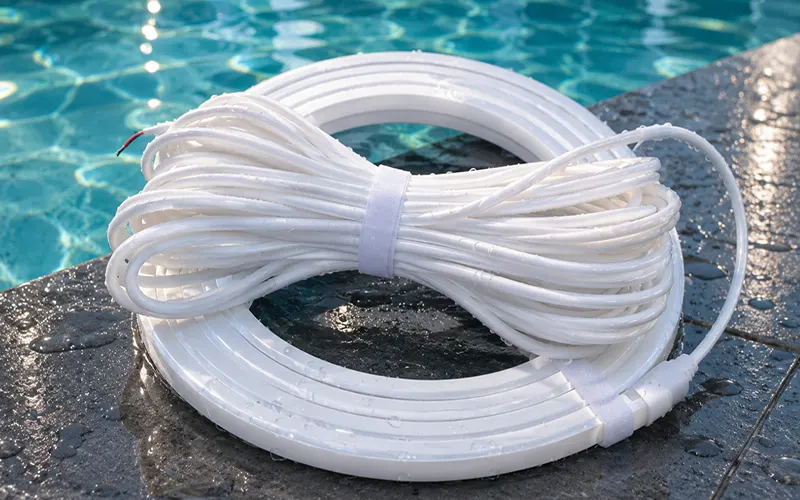
Swimming pools, water features, and outdoor landscapes often require lighting fixtures that combine aesthetic appeal with reliable waterproofing. This is where IP68-rated silicone neon lights prove invaluable. Featuring a flexible silicone housing and an exceptionally high ingress protection rating (IP68), these LED neon lights—when installed according to the manufacturer’s specifications—can deliver a uniform, continuous lighting effect, whether underwater or in various outdoor environments.
So, what is IP68 silicone neon lights? How does their IP68 waterproof protection? Can we install these fixtures inside swimming pools? Can we cut to size as needed? And is it possible to customize their power output and color temperature to suit specific requirements?
What Is IP68 Waterproof Protection?
IP68 is an ingress protection rating that describes how well an electrical product resists the entry of solid particles and water. The rating follows the IEC 60529 classification system.
The letters and numbers have specific meanings:
- IP: Ingress Protection.
- 6: The highest solid-particle protection level in the IP code, indicating dust-tight protection under the applicable test conditions.
- 8: Protection against immersion in water under conditions specified by the manufacturer and agreed upon for the product.
Unlike IP65 or IP67 ratings, the IP68 rating is intended for equipment that must be capable of withstanding immersion under specific conditions. However, the precise immersion depth and duration for IP68-rated products can vary between different manufacturers.
For instance, two LED products that both carry an IP68 rating may have different permissible immersion depths.
An IP68 rating does not imply that a product can remain submerged indefinitely or be used directly in a swimming pool. Its actual suitability depends on factors such as the manufacturer-specified immersion depth and duration, the sealing design, the power supply method, and local electrical safety requirements.
IP67 vs. IP68 LED Neon Flex: What Is the Difference?
Both IP67 and IP68 offer complete protection against dust, but they differ in their level of protection against water immersion. In fact, they belong to different categories of water-resistance ratings.
| Feature | IP67 | IP68 |
|---|---|---|
| Dust protection | Dust-tight | Dust-tight |
| Water protection | Temporary immersion under specified test conditions | Immersion underwater and swimming pool specified conditions |
| Typical consideration | Short-term immersion exposure | Applications requiring more demanding immersion protection |
| Swimming pool suitability | Depends on the product and installation | Depends on the product’s verified underwater rating and installation |
| Installation requirements | Follow product specifications | Follow product specifications and specified immersion limits |
Products with an IP67 rating are typically tested through short-term immersion under standardized conditions. Products with an IP68 rating, by contrast, must meet specific immersion requirements defined for that particular product.
In swimming pool environments, the water contains chemicals such as chlorine, and in some cases, salt. Long-term exposure to such conditions can affect a fixture’s materials, connectors, seals, and electrical components.
Always ensure that you select products explicitly approved or designated for such underwater applications. Additionally, verify their chemical resistance, operating voltage, installation instructions, and compliance with local electrical codes.
What Is a Silicone Neon Light?
Neon-style lighting (commonly referred to as “LED flexible neon” or “LED neon tubing”) is a type of flexible lighting product made from silicone. It features LED chips housed within a protective casing, creating the appearance of a continuous line of light.
Unlike traditional neon lights, which rely on gas-filled glass tubes to produce light, LED flexible neon uses solid-state LEDs—eliminating the need for fragile glass tubing or neon gas.
Modern LED neon lights typically feature a casing made of silicone or other engineered polymers. This casing acts as a light diffuser, obscuring the outlines of individual LED chips and giving the product a smooth, uniform appearance.
How Does LED Neon Flex Work?
A complete LED flexible neon light system consists of three main components:
- LED source: Responsible for generating light, LED strip.
- Flexible housing: Made of silicone or other specific materials, this protects the light source and diffuses the light.
- Electrical connections: Typically featuring 30cm-long lead wires at either end to supply power to the LEDs.
Thanks to their flexible construction, LED flexible neon lights are ideally suited for outlining architectural contours, creating decorative shapes, and illuminating curved surfaces.
Depending on the design, LED flexible neon lights can offer single-color, tunable white, RGB, or RGBW lighting, or even provide independently controllable lighting effects.
What Is IP68 Silicone Neon Light?
IP68 silicone neon lights are a type of flexible LED neon product that meets the IP68 ingress protection standard under specified test conditions. Please note, however, that standards can vary between manufacturers; it is advisable to carefully verify the specific criteria used to define their “IP68” rating.
These lights combine an LED light source with a silicone housing, incorporating specialized sealing and connection structures to provide protection against dust and water.
Unlike traditional LED strips, which leave circuit components exposed, well-designed silicone neon lights fully encapsulate the light source within a protective casing. This construction allows them to withstand demanding installation environments and even function in certain underwater lighting applications.
Key Features of IP68 Silicone Neon Lights
1. High-Level Waterproof Protection
The high waterproof rating of IP68 silicone neon lights allows users to install them underwater and in swimming pools, unlike standard decorative LED strips.
2. Durable Housing
Silicone material offers a combination of excellent flexibility and resistance to environmental aging. However, factors such as the silicone formulation, structural design, ambient temperature, ultraviolet (UV) exposure, and contact with pool chemicals can affect its actual performance.
3. Diverse Lighting Effects
Depending on the model, IP68 silicone neon lights can provide single-color illumination, white light, RGB color-changing effects, and even addressable (intelligently controlled) dynamic lighting effects.
Why Choose Silicone Instead of an Ordinary LED Strip?
If your project involves indoor areas prone to moisture or water, or requires outdoor lighting—and if you need both a continuous, seamless glow and an external protective housing—then silicone neon flex strips are an ideal solution.
Furthermore, for outdoor or underwater applications, the integrity of the entire system is critical. Every component, including end caps, cable entry points, seams, connectors, and power connection points—must meet the specific demands of the installation environment.
Where Can IP68 Silicone Neon Lights Be Used?
Our IP68 silicone neon lights are suitable for a wide range of architectural, landscape, decorative, and water-related projects—provided that the specific model chosen meets the requirements of the intended installation environment.
Swimming Pools and Water Features
Designed specifically for underwater use, IP68-rated flexible neon lights can be used to outline the perimeter of swimming pools, illuminate specific recesses, and enhance the visual impact of fountains and various water features.
Landscape and Garden Lighting
Selecting appropriate IP68-rated models can accentuate garden structures, steps, pathways, and retaining walls, as well as landscape areas prone to rainwater runoff or occasional submersion.
If a fixture is intended for long-term underwater submersion, it must meet specific standards for underwater use, rather than merely satisfying general requirements for outdoor installation.
Architectural Lighting
Flexible neon strips can be used to outline building contours, columns, curved structures, and various decorative architectural details. The suitability of a product for outdoor use depends on its UV resistance, operating temperature range, installation method, and ingress protection (IP) rating.
Commercial and Hospitality
Hotels, resorts, restaurants, and entertainment venues can utilize flexible neon lighting to create unique visual effects around water features, in outdoor lounge areas, and along architectural details.
Decoration and Signage
Flexible neon lights can be used to create illuminated lettering, outlines, and a variety of custom shapes. If the signage is to be installed outdoors (where it may be exposed to rain) or near a water source, please select an appropriate ingress protection (IP) rating based on the specific environment.
What Wattages and Color Temperatures Are Available for IP68 Silicone Neon Lights?
Currently, we offer two models T1616 and S1616 that support an IP68 waterproof rating. The standard power rating is 10W per meter, but we also offer custom power ratings.
We also offer a wide range of color temperature options, including single-color, dual-color, and RGB versions; custom color temperatures can also be provided upon request.
Common Power Options
Depending on the manufacturer and model, IP68 flexible silicone neon LED strips are available in various power configurations. Our version is rated at 10W/m.
Low-power versions are suitable for contour decoration and subtle accent lighting, while high-power versions can be chosen for a more striking visual impact.
Before choosing a wattage, check:
- Power consumption per meter.
- Total installed length.
- Required power-supply capacity.
- Voltage drop over long cable runs.
- Maximum permitted run length.
- Heat dissipation and installation conditions.
For example, a 10m installation using a 10 W/m neon strip has a nominal lighting load of 100 W.
Select a power supply that matches the product’s voltage and electrical specifications and provides sufficient capacity for the load and operating conditions. Install the power supply in a location and enclosure suitable for its environment.
Color Temperature Options
For white-light products, color temperature is measured in kelvin (K). Common lighting options include:
| Color temperature | Appearance | Typical application |
|---|---|---|
| 2700K–3000K | Warm white | Relaxing, decorative environments |
| 4000K | Neutral white | Modern architectural and landscape lighting |
| 5000K–6500K | Cool white to daylight-like white | Crisp, high-contrast lighting effects |
Similarly, you can choose RGB products, which are capable of displaying a wide range of colors, or RGBW models, which feature an additional, dedicated white-light channel. When paired with a compatible controller, addressable models can even produce dynamic lighting effects.
For swimming pool lighting, the ideal color depends on the atmosphere you wish to create, the surrounding construction materials, the visual appearance of the water, and your overall lighting design scheme.
Can IP68 Silicone Neon Lights Be Cut?
Our IP68-rated silicone neon lights can be cut at 50mm intervals. While they can be trimmed to specific lengths as needed, please note that not all models support arbitrary cutting; we do offer custom-length options.
However, we generally advise against cutting them, as maintaining the IP68 waterproof rating can be challenging. Before attempting any cuts, always consult the manufacturer’s instructions to verify the permitted cutting points, the minimum cutting unit length, and the required sealing procedures.
How to Cut an IP68 Neon Tube Safely?
While we offer custom-length options, we do not recommend that customers cut IP68-rated neon LED strips themselves. If you must cut them, please follow the steps below:
Identify the cutting point
Determine the permitted cutting interval; the specific cutting length varies by manufacturer.
Disconnect the power supply
Always turn off and disconnect the power supply before making any modifications. Never cut the LED neon strip while it is powered on.
Measure the required length
Carefully measure the installation area and confirm the cutting location before making any cuts.
Follow the recommended cutting procedure
Cut only at the designated locations using appropriate tools. Cutting elsewhere may damage the circuitry or cause the remaining sections to malfunction.
Restore the waterproof sealing system
Use the end caps, sealants, adhesives, or other sealing components specified by the manufacturer. Ensure that the sealing materials have reached their required curing time before conducting any tests or exposing the unit to water.
Test the assembled product
Before installation, follow the testing procedures provided by the manufacturer. Please note that if a product has been cut or repaired, it cannot be assumed to retain its original IP68 ingress protection rating until the necessary sealing has been applied and verified.
Does Cutting Affect Waterproof Performance?
Yes. Cutting can expose the internal circuit and create a path for water to enter the housing. Incorrect sealing can lead to corrosion, electrical failure, or permanent damage.
For underwater projects, a factory-cut length or a factory-sealed custom assembly may be the better choice. If field cutting is permitted, follow the manufacturer’s exact procedure and verify that the completed assembly is suitable for the intended immersion conditions.
Can IP68 Silicone Neon Lights Be Used Underwater and in Swimming Pools?
Yes, our IP68-rated silicone neon lights are specifically designed and verified for underwater use, making them suitable for certain swimming pool and underwater lighting applications. More details, pls check Guide to LED Strip for Swimming Pool
Swimming pool environments pose particular challenges because lighting equipment must withstand prolonged submersion, exposure to chlorine, salt, and cleaning chemicals, temperature fluctuations, and various maintenance activities.
The specifications support the intended underwater use. Confirm the electrical safety requirements, installation conditions, and chemical compatibility before putting the product into service.
Conclusion
IP68 silicone neon lights suit swimming pools and outdoor lighting applications. They are an ideal choice for projects that require flexible installation, continuous illumination, and a high level of water resistance.
Before purchasing, be sure to verify specifications such as submersion conditions, operating voltage, power requirements, color options, cutting instructions, chemical resistance, and electrical safety standards. Hburv checks help prevent compatibility issues and ensure a more robust, reliable installation. Pls contact us if any needs.