
One of the most compelling reasons for the appeal of LED strips is the ever-expanding range of color temperature capabilities they offer. From the early days of single-color LED strips (ranging from 2700K to 6000K) to today’s sophisticated RGB vs RGBW vs RGBIC LED strip lights, users often find themselves puzzled when making a selection: What exactly distinguishes them? And which type is best suited to my specific lighting needs?
This article will provide an in-depth exploration of these three types of LED strip lights: RGB vs RGBW vs RGBIC LED strip lights. We are explaining their structural principles, differences in lighting effects, and typical application scenarios. Our goal is to help you easily distinguish between them and select the product that best meets your requirements.
What Are RGB LED Strips?
RGB stands for “Red, Green, Blue.” This is the most basic and common type of colored LED light strip.
Its operating principle is based on the additive color mixing of the three primary colors of light: by adjusting the brightness of the red, green, and blue LED chips and blending their light output, a rich spectrum of colors is created. More, pls check RGB vs. RGBW LED Strip Lighting: What’s the Difference?

How It Works
Red, green, and blue LED chips are arranged in close proximity along the length of the strip. Using a controller, you can adjust the brightness of each individual color from 0% to 100%. For instance, mixing red and blue produces purple; turning red, green, and blue to their maximum brightness simultaneously produces white (though this resulting white tends to be cool-toned and slightly bluish).
Advantages
The cost is slightly higher than that of monochromatic (single-color) strips. However, they offer the widest range of options and are capable of generating millions of vibrant colors. They are ideally suited for settings that require dynamic color changes.
Disadvantages
They are unable to produce a pure, warm white light. The “white light” generated through mixing is typically of lower quality—often appearing pale or bluish—making it unsuitable for use as primary lighting or in reading environments where high-quality white light is essential.
What is an RGBW LED Strip?
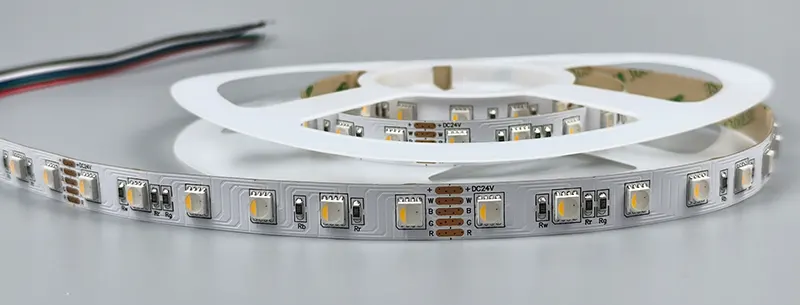
RGBW represents a key upgrade built upon the standard RGB platform. In addition to the red, green, and blue chips, it incorporates an extra, independent pure white (W) LED chip.
If your lighting needs call for pure white light alongside RGB colors, then this RGBW LED strip is the ideal choice for you. More information, pls read What is DMX RGBW LED Strip Light and How Does It Work?
Working Principle
RGBW LED strips feature four independent sets of chips: R, G, B, and W. This means that, in addition to mixing various colored lights just like a standard RGB strip, they can also directly emit a pure, color-neutral white light.
Typically, the dedicated white chip produces either warm white light (approx. 2700K–3000K) or cool white light (approx. 6000K), offering a level of comfort closer to that of traditional lighting. Depending on user requirements, the 6000K option is the more frequently chosen choice.
Advantages
- High-Quality White Light: Delivers a pure white light that is truly suitable for everyday illumination and reading.
- Wider Color Gamut: When rendering certain light or pastel shades, the addition of white light ensures that colors appear more accurate and softer.
- Higher Energy Efficiency: To produce white light, utilizing a dedicated white LED chip is more energy-efficient than simultaneously illuminating the three RGB chips.
Disadvantages
The price is slightly higher than that of RGB LED strips with the same specifications, due to the inclusion of an additional, independently emitting white chip. Consequently, the production cost is slightly higher.
What are RGBIC LED Light Strips?
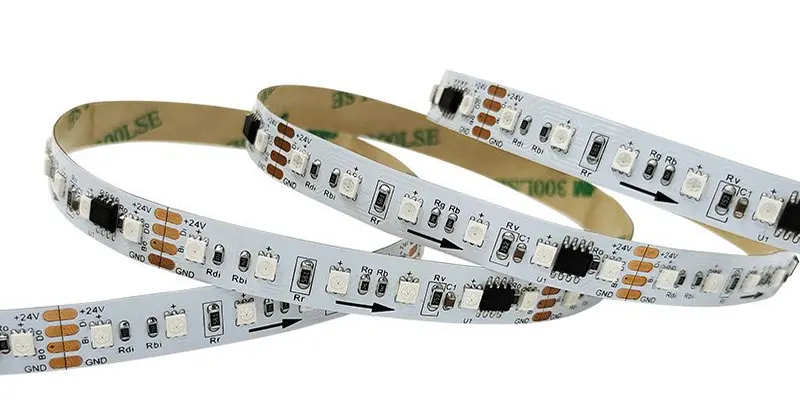
In the term “RGBIC,” the “IC” stands for “Integrated Circuit”—this constitutes the most fundamental difference distinguishing it from standard RGB and RGBW light strips.
RGBIC light strips feature an innovative physical design; they integrate tiny control chips (ICs) directly onto the circuit board of the strip, linking each individual LED chip—or small clusters of chips—to its own dedicated controller.
Advantages
- Advanced Dynamic Effects: Capable of producing complex visual effects—such as flowing light and rainbow waves—that are beyond the capabilities of standard RGB LED strips.
- Segmented Control: A single LED strip can simultaneously display multiple colors, creating lighting scenes that possess a profound sense of depth and artistic flair.
Disadvantages
Furthermore, due to their unique operating mechanism, they typically cannot be used with standard RGB controllers; instead, they require a dedicated, proprietary controller.
A Comparison of the Key Differences Between RGB vs RGBW vs RGBIC LED strip lights
| Features | RGB | RGBW | RGBIC |
| Key Features | Basic Color Ambient Lighting | Color + Pure Functional White Light | Dynamic Effects + Color Ambient Lighting |
| White Light Quality | Mixed (Bluish/Purplish) | Independent Chip: Pure and Bright | Mixed (Bluish/Purplish) |
| Simultaneous Color Display | No (Entire strip is a single color) | No (Entire strip is a single color) | Yes (Supports multi-color streaming effects) |
| Chip Configuration | 3-in-1 (R+G+B) | 4-in-1 (R+G+B+W) | 3-in-1 (R+G+B) + Separate IC |
| Number of Pins | 4 Pin | 5 Pin | 3 Pin(V+/GND/Data) |
| Price | Most Economical | Relatively high (due to the presence of the W chip) | Highest (due to the presence of an IC chip) |
Can a Standard RGB Controller Be Used with RGBIC LED Strips?
This is a critical yet frequently misunderstood issue: the answer is no. Standard RGB or RGBW controllers are completely incompatible with RGBIC LED strips in terms of both communication protocols and electrical design.
RGBIC LED strips require precise communication with their built-in IC chips to enable segmented control, whereas standard controllers can only transmit signals that cause the entire strip to change uniformly.
If you attempt to force-connect an RGBIC strip to a standard controller, the most likely outcome is that the strip will fail to function entirely; alternatively, it may exhibit erratic displays or flickering, and there is even a risk of damaging either the strip or the controller.
Therefore, you must use the specific controller and mobile application originally provided by the brand of your RGBIC LED strip.
How to Choose a Controller for RGBIC LED Strips?
If you are selecting a controller for RGBIC LED strips, it is essential to use the specific controller and mobile application originally provided by the brand of the LED strips you purchased. Please verify the following details:
- You must use a dedicated RGBIC controller (typically included as a standard accessory by the manufacturer).
- If you are utilizing a smart control system (such as Tuya, Govee, Magic Home, etc.), please ensure that the controller is compatible with the specific IC chip model used in your strips (e.g., WS2811, WS2812B, SK6812, etc.).
- Verify that the voltage matches (common voltages are DC 12V or DC 24V).
- During installation, pay close attention to the signal direction indicators (arrows) to ensure consistent data flow; otherwise, the LED strips will not display their lighting effects correctly.
Which LED Strip Light Is Best Suited for Your Setting?
Once you have a detailed understanding of the differences between them, you can make a selection based on your specific needs. You may also refer to the scenarios outlined below for guidance.
Choose RGB:
Ideal for: Limited budgets; primarily for creating a colorful atmosphere—such as in gaming rooms, bars, or KTV feature walls—where there are no specific requirements regarding white light quality.
Choose RGBW:
Ideal for: Home living rooms, bedrooms, and kitchens that require both colorful ambient lighting and high-quality white light to serve as primary or supplementary illumination.
Naturally, it is also suitable for users seeking superior color fidelity and visual comfort. In a home environment, this option strikes the optimal balance between functionality and cost.
Choose RGBIC:
Ideal for: Those seeking ultimate visual effects; those wishing to create personalized, artistic light displays. Examples include media walls, home theaters, commercial displays, and content creation backdrops; also suitable for tech enthusiasts.
Conclusion
In summary, RGB vs RGBW vs RGBIC LED strip lights cater to users with distinct installation objectives, requirements, and budgets. The key to making the right decision lies in determining whether you require pure white light (opt for RGBW) or if you are seeking sophisticated, dynamic flowing light effects (opt for RGBIC).
We offer a comprehensive range of RGB, RGBW, and RGBIC products, and our professional engineers are available to assist you in selecting the most suitable controllers and power supplies.
FAQs
Yes, you can. Just like standard LED light strips, RGBW strips feature clear cut marks at regular intervals. Be sure never to cut the strip at any location other than these designated marks.
In terms of brightness, it primarily depends on power output and lumen count. RGBW light strips are generally brighter because they incorporate dedicated white light chips, which provide higher brightness and more natural color rendering—whether displaying pure white light or mixed colors.
No, they cannot, as they lack a dedicated white LED chip. However, they can simulate white light by mixing the three RGB colors; the resulting color temperature tends to be cool or bluish. If you require high-quality white light, please opt for RGBW light strips instead.
We do not recommend doing so. The two types of LED strips differ in their circuit structures, signaling methods, and control protocols; connecting them together may result in damage or cause them to malfunction. It is best to use the corresponding controller and power supply for each type separately.