
What do you use to connect cut LED strips? Many people encounter this question during strip installation. So how do we perfectly connect cut strips, or easily bend or branch them? The answer lies in a seemingly insignificant yet crucial component—the LED strip connector. LED strip connectors come in various types, including waterproof and non-waterproof, and also available in single-color, dual-color, and RGB versions. Next, we’ll provide a comprehensive guide on how to select the most suitable LED strip connector for your project.
What are LED Strip Connectors?
LED strip connectors are accessories specifically designed to connect LED strips to power supplies and controllers without soldering, or to connect two strips to achieve extensions, corners, or branching layouts.
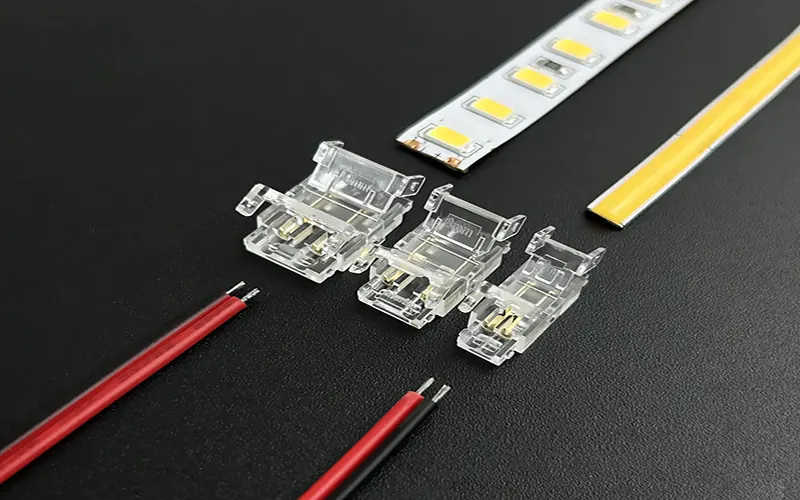
These effectively replace traditional soldering methods, significantly reducing installation difficulty and maintenance costs.
Advantages:
- Quick Connect: Allows non-professional users to quickly and safely connect circuits.
- Flexible Layout: Provides L-shaped, T-shaped, and other corner connectors to achieve complex lighting geometries.
- Power Input: Connects the LED strip to the driver power supply or controller.
Common Types of LED Strip Connectors
LED strip connectors can be categorized into the following main types based on their function and shape:
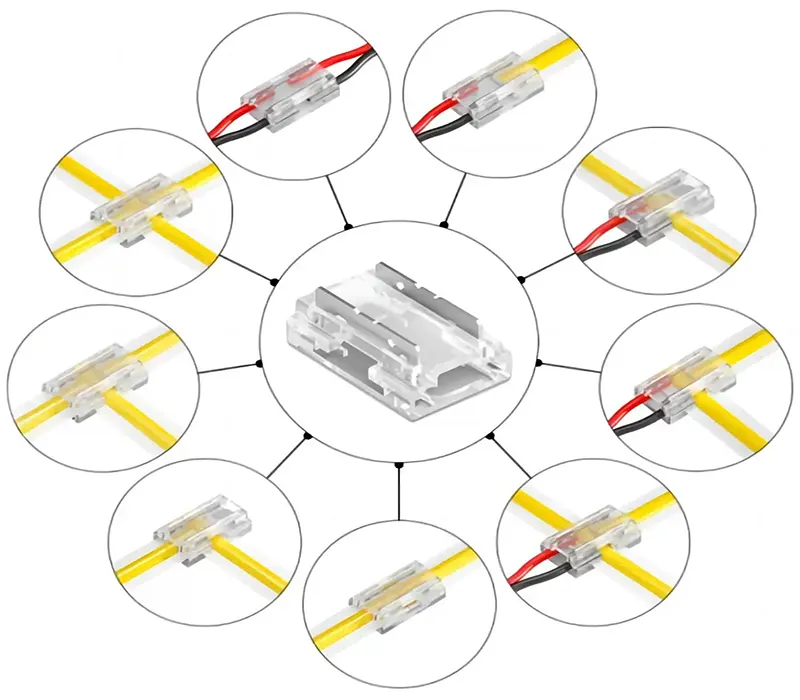
Strip-to-Wire Connectors: Used to connect the end of the LED strip to the output terminal with a wire for power supply or controller connection. Typically a solderless snap-fit type.
Strip-to-Strip Connectors: Used to connect two LED strip segments, enabling strip extension or seamless connection.
Shape Connectors (L/T/X types):
L-type: For 90-degree right-angle turns.
T-type: For T-shaped three-way branching.
X-type: For cross-shaped four-way branching.
DC/Screw Terminal Adapters: Used to connect LED strips to standard DC male/female plugs, or to screw-fixed terminal blocks.
Determine Connector Specifications Based on LED Strip Type
This is the most crucial first step in selecting a connector, ensuring a perfect match between the connector and the LED strip’s physical and electrical specifications. The number of connector pins must match the number of copper pads on the LED strip:
- 2-Pin: Monochrome (e.g., white light, warm white light)
- 4-Pin: Standard RGB
- 5-Pin: RGBW or RGBWW
- 6-Pin: RGB+CCT (Full-color with color temperature adjustment)
Matching LED Strip Width (PCB Width):
Connectors are available in different sizes such as 8mm, 10mm, and 12mm. Your LED strip’s PCB width must precisely match the connector’s slot width to ensure good contact and a secure clamping.
Special Considerations for Addressable LED Strips:
For addressable LED strips such as the WS2812 and WS2813, in addition to the power line, the pins of the data line or backup data line (BI) must also be matched to ensure stable signal transmission.
Connection Method Selection: Solderless vs. Soldered Adapters
Solderless Connectors
Solderless connectors are easy to use and suitable for home users and DIY projects. Users simply insert the LED strip into the connector.
Then press the clamps on the connector to achieve a stable electrical connection. These connectors are commonly used for short-term or temporary lighting installations, especially suitable for users without soldering tools.
Solder Connectors
Solder connectors offer greater stability, making them particularly suitable for large-scale installations or long-term use of light strips. By using solder connectors, you can ensure a stable current flow and reduce malfunctions caused by poor contact.
While soldering requires some skill and time, for demanding applications, solder connectors are undoubtedly the better choice.
What are the Installation Environment and Requirements for LED Strip Connectors?
When selecting LED strip connectors, the installation environment and requirements are crucial. Here are some important considerations:
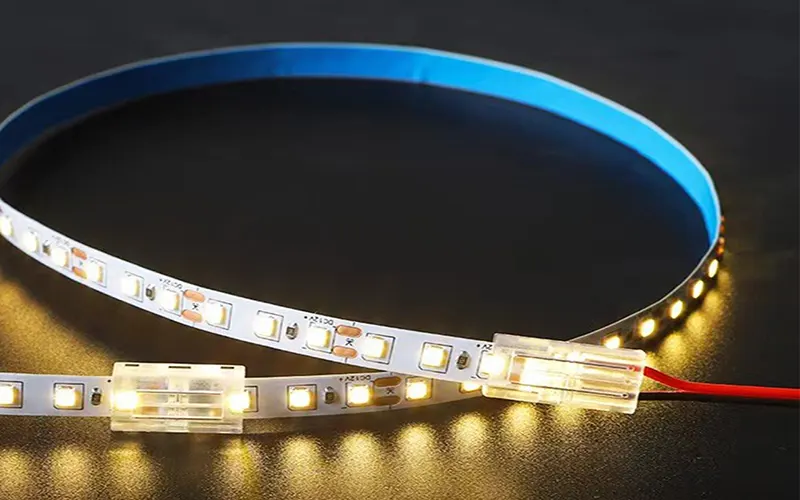
Indoor vs. Outdoor Use
If your LED strip is intended for outdoor or humid environments, be sure to choose waterproof connectors. Waterproof connectors effectively prevent rain or moisture from entering the connection points, preventing short circuits or damage.
Installation Space
Consider the size of your installation space and select the appropriate connector. Some LED strips are installed in corners or confined spaces, which may require right-angle connectors to achieve flexible connections.
Installation Space Vibration and Shock
On vehicles, stages, or frequently moved display stands, soldered adapters with heat-shrink tubing encapsulation are more stable and reliable than any solderless connector.
How to Install a Solderless LED Strip Connector?
Installing a solderless LED strip connector is a simple and intuitive process. Follow these steps to easily complete the process:
Preparation: Ensure the LED strip power is completely off. Clean the pads at the end of the LED strip with an alcohol swab to remove any oil or oxides; this is crucial for good conductivity.
- Open the Connector: This usually requires gently prying or sliding open the connector’s clips or cover.
- Insert the LED Strip: Smoothly insert the prepared LED strip end (aligning the cut-out pad area with the metal contacts inside the connector) into the connector slot. Ensure the LED strip is fully inserted and the pads are perfectly aligned with the contacts.
- Tighten the Connector: Press down or snap the connector cover/clip firmly until you hear a “click,” indicating it is locked. This process forces the internal metal contacts to firmly pierce or clamp the pads, forming a circuit connection.
- Test Connection: Turn on the power and test if the LED strip lights up correctly. If problems are found, disconnect the power and check if the LED strip is inserted correctly and if the pads are clean.
Conclusion
Choosing the right LED strip connector not only extends the lifespan of the strips but also ensures their proper functioning after installation. When selecting connectors, you need to consider several factors, including strip type, voltage requirements, installation environment, and installation method.
If you are planning to install LED strips, be sure to choose the correct connectors based on your needs. We offer a variety of high-quality LED strip connectors to help you easily complete your lighting projects!
FAQs
Theoretically, yes, but it’s strongly discouraged. Connectors provide a physical connection, but different LED strips may have different brightness, color temperature, voltage, and current. We worry about some strips being too dim or too bright, or even having a shortened lifespan.
Yes, but it’s not recommended. Most solderless connectors can be reused several times. However, each disassembly can reduce the clamping force of the metal clips, affecting the reliability of subsequent connections.
Yes, possibly. Any additional connection point introduces resistance. Compared to professionally soldered connections, solderless connectors, especially lower-quality ones, have higher contact resistance at their internal metal contacts, potentially leading to a slight voltage drop and heat generation.
No, they usually won’t cause a noticeable change in brightness, but they will increase resistance. L-type and T-type connectors are designed for complex corner or branching wiring.
No. Single LED strip connectors only have 2 pins (+V and GND). RGB LED strips require 4 pins (+V, R, G, B) to function properly. A pin mismatch will prevent the correct connection of all necessary power and control lines.