
RGB LED strips and IC RGB LED strips are two common choices on the market. They both seem capable of achieving colored lighting effects, but their performance in real-world applications differs drastically. Many consumers are unclear about the differences between RGB LED strips and IC RGB LED strips, and which one is more suitable for their projects. This article will provide a comprehensive analysis of the differences, advantages, disadvantages, and selection advice for both, helping you easily find the most suitable type of LED strip.
What is an RGB LED Strip?
An RGB LED strip is the most basic colored LED lighting product, composed of red, green, and blue LEDs. Its working principle is based on color mixing: by adjusting the brightness ratio of the three primary colors, various colors can be mixed.
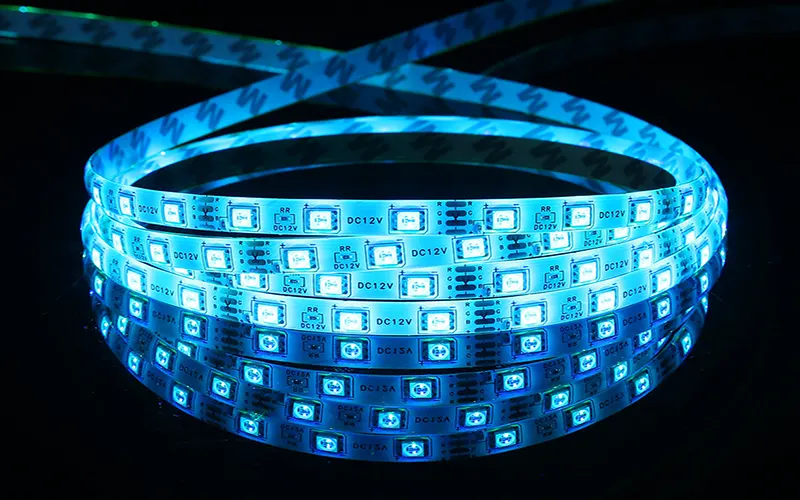
Traditional RGB strips have a relatively simple structure. All the LEDs on the strip are connected in parallel, sharing four control lines: one common positive (or negative) terminal and three color control lines (R, G, B).
The RGB LED strip controller adjusts the voltage or PWM duty cycle of these three channels to change the brightness of each color, thus achieving color changes.
RGB strips typically operate on 12V or 24V and can be driven by a simple RGB controller. Various types of controllers are available on the market, including infrared remote controls, mobile app controllers, and voice-activated controllers, with prices ranging from tens to hundreds of yuan. This type of strip is suitable for scenarios requiring overall ambient lighting, such as living room feature walls, bedroom light strips, and cabinet lighting.
What is an IC RGB LED Strip?
IC RGB LED strips, also known as programmable LED strips or digital LED strips, represent a significant technological upgrade from traditional RGB strips. “IC” stands for Integrated Circuit, meaning each LED has an independent control chip integrated inside or next to it.
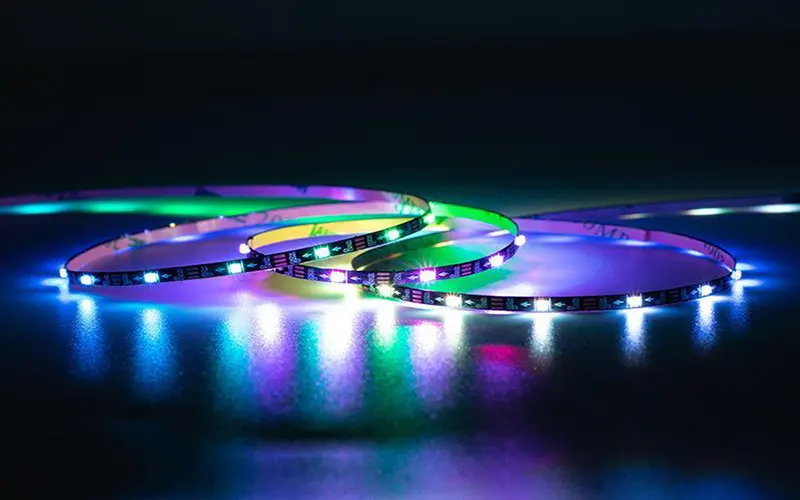
Common IC chip models include WS2811, WS2812B, WS2813, and SK6812. These chips endow each LED with independent “intelligence”—they can individually receive and process digital signals, independently controlling their own color and brightness, unaffected by other LEDs.
The operation of IC RGB LED strips is completely different from traditional RGB strips. Control signals are transmitted digitally, typically requiring only one data line (plus a power line). Data signals are passed sequentially, starting with the first LED and cascading. Each LED’s IC chip extracts its own data packet (usually 24 bits: 8 bits red + 8 bits green + 8 bits blue), then passes the remaining data to the next LED.
This design achieves true “pixel-level” control. Each LED is an independent pixel, capable of displaying different colors and brightness levels. This means you can simultaneously make the first LED display red, the second green, the third blue, and so on. This capability enables the creation of complex animation effects, flowing lights, chasing effects, and even video playback.
IC RGB LED strips require specialized digital controllers capable of generating digital signals that conform to the chip’s protocol. Control methods include pre-programmed controllers, open-source hardware programming such as Arduino, professional LED control software (such as Jinx and Glediator), and professional systems supporting ArtNet or DMX protocols.
What Is the Essential Difference Between RGB and IC RGB LED Strip?
We analyze the fundamental differences between RGB and IC RGB from multiple perspectives to help customers better understand the differences and make a better choice.
Control Method
Traditional RGB LED strips use analog control, with the controller outputting a continuously changing voltage or PWM signal. The entire strip shares the same control signal, thus only achieving overall color changes. This is like a room with only one master switch, controlling only the on/off state and brightness of all the lights.
However, IC RGB LED strips use digital control, with the controller sending discrete digital data packets. Each LED has its own “address” and can receive dedicated control commands. This is like a smart home system, where each light has an independent switch and regulator, allowing for individual control.
Achieved Effects
Traditional RGB LED strips offer relatively limited effects: solid color display, color gradients, breathing effects, flashing, etc. All these effects are synchronized across the entire strip. While millions of colors can be displayed through color mixing, only one color can be displayed at any given time.
IC RGB LED strips offer an extremely rich array of effects: flowing light effects, rainbow chasing, wave effects, flame simulation, pixel animation, music spectrum visualization, video playback, and more. Because each LED is independently controllable, multiple colors can be displayed simultaneously, creating dynamic and complex visual effects.
Wiring and Installation Complexity
RGB LED strips require four wires: V+, R, G, and B, making wiring relatively simple. When connecting multiple strips in parallel, simply connect the wires of corresponding colors together, making installation relatively easy.
IC RGB LED strips typically require only three wires: V+, DATA, and GND, seemingly simpler, but actual installation requires attention to signal directionality. IC strips have clearly defined signal input and output terminals and must be connected in the correct direction. When connecting multiple strips, they need to be connected in series, with the signal flowing from the output of the previous segment to the input of the next.
Control Distance and Signal Stability
RGB LED strips use analog signals, allowing for relatively long transmission distances, typically 10-20 meters without signal amplification. They are less sensitive to interference and have lower installation requirements.
IC RGB LED strips use high-speed digital signals, limiting transmission distance. It is generally recommended not to exceed 5 meters. Excessive distances may cause signal attenuation, color distortion, or flickering. They are more sensitive to electromagnetic interference, and shielding or signal amplifiers may be necessary in complex electromagnetic environments.
System Scalability
Traditional RGB systems are easy to expand; adding LED strips simply requires parallel connections. However, it’s crucial to ensure that the controller and power supply’s maximum load are not exceeded. Regardless of the number of LED strips connected, all strips will always display the same effect.
IC RGB systems can theoretically cascade hundreds or even thousands of LEDs, each independently controlled. However, as the number of LEDs increases, the refresh rate decreases, requiring a more powerful controller to handle the large amounts of data. Professional applications may require dividing the LED strips into multiple independent control units.
Why is There Such a Large Price Difference Between RGB and IC RGB LED Strips?
When comparing standard RGB LED strips with IC RGB LED strips, the first thing many consumers notice is the difference in price. For strips of the same length, the cost of an IC RGB strip is often two to five times that of a traditional RGB strip. Without understanding the fundamental differences between the two, it is difficult to comprehend why such a wide price gap exists.
Chip Costs
Traditional RGB LED strips consist solely of the LED beads themselves and do not require additional control chips. In contrast, every single LED on an IC-integrated RGB LED strip must be equipped with its own independent control IC chip.
Taking the WS2812B as an example: although the unit cost per chip is relatively low, when a one-meter strip contains 60 or more LEDs, the cumulative cost of the chips becomes quite substantial. Furthermore, these IC chips require precise packaging integration with the LED beads, which increases the complexity and cost of the manufacturing process.
Differences in PCB Design Complexity
The PCB design for standard RGB LED strips is relatively simple, requiring only four parallel traces. In contrast, IC-based RGB LED strips require a dedicated data line for each individual LED to ensure the accurate transmission of signals.
This cascaded architecture demands a more sophisticated circuit design and higher manufacturing precision—factors that are directly reflected in the overall cost.
Controller Costs
The controllers for standard RGB LED strips feature a simple architecture; they merely need to generate three independent PWM signals. Consequently, controllers costing just a few tens of yuan—widely available on the market—are sufficient to meet basic requirements.
In contrast, controllers for IC-based RGB LED strips must generate high-speed digital signals and process substantial volumes of data, typically necessitating more powerful processors and more sophisticated software algorithms. A programmable IC strip controller capable of supporting a wide array of lighting effects often carries a price tag ranging from several hundred to well over a thousand yuan.
R&D and Technological Investment
IC RGB LED strip technology encompasses multiple technical domains—including digital signal processing, communication protocol design, and software programming—requiring manufacturers to invest substantial R&D resources. These costs are ultimately reflected in the product’s price.
When Should You Choose RGB LED Strips? When Should You Choose IC RGB LED Strips?
The choice of which type of LED strip to select depends entirely on your specific project requirements and budget. You should evaluate the situation based on the following criteria:
RGB LED Strip Application Scenarios
- Requiring only a single color change or fixed color effect;
- projects with limited budgets and a focus on cost-effectiveness;
- Do not require dynamic control or complex
- Small-scale projects requiring simple connections.
IC RGB LED Strip Application Scenarios
- Requiring dynamic lighting effects (follow-the-light, gradient, flowing light, etc.)
- Aiming to achieve music-inspired, zoned, or DIY lighting effects
- For commercial or stage projects with high visual requirements
- Applications requiring advanced control systems (such as DMX512, SPI controllers)
How to Choose the Right IC RGB LED Strip?
If you have decided to use IC RGB LED strips for your project, consider the following details before making your selection to help you choose the most suitable product:
Select the Appropriate Chip Model
Common models include the WS2811 (external IC), WS2812B (integrated IC), SK6812 (features a dedicated white light channel), and WS2815, among others. The specific model chosen determines the lighting effects and control method.
Confirm the Operating Voltage
The market primarily offers three voltage versions: 5V, 12V, and 24V. 5V: Offers high brightness but has a shorter transmission distance;
12V / 24V: Suitable for long-distance installations, featuring lower voltage drop.
Select the Appropriate Controller
Based on the protocol type, choose an SPI, DMX512, Bluetooth, or Wi-Fi controller to ensure compatibility.
Waterproof Rating
Indoor Use: IP20 is sufficient.
Humid Environments: IP65 (with waterproof coating).
Outdoor or Underwater Use: Select an IP67 or IP68 protection rating.
Consider LED Density and Power Consumption
The higher the LED density, the more refined the lighting effect; however, power consumption increases accordingly. Be sure to select a power supply with adequate capacity to match the load.
Conclusion
RGB LED strips and IC RGB LED strips actually cater to two entirely distinct directions within the field of LED lighting engineering. Traditional RGB strips—characterized by their simplicity, reliability, and cost-effectiveness—satisfy the general market’s fundamental requirements for colored lighting; conversely, IC RGB LED strips, with their pixel-level control capabilities and boundless creative potential, serve as powerful tools for professional applications and high-end projects.
If you are seeking the ultimate in creative lighting design and dynamic visual effects, IC RGB LED strips offer a world of infinite possibilities. We provide a wide range of high-quality IC RGB LED strips and standard RGB strips—spanning from entry-level options to professional-grade solutions—to help you bring every one of your creative visions to life.
FAQs
There are some differences. RGB LED strips are simpler to install, usually requiring only the connection of a controller and power supply. IC RGB LED strips are more complex to install, requiring proper data cable connections, and may require a signal amplifier for long-distance use.
Yes, but they need to be controlled separately. Each type of strip requires its own independent controller and power system. Synchronization can be achieved through a smart home system or a unified control platform, but the circuitry must be separate.
First, check the power connection to ensure stable voltage. Second, check the signal cable connections for secureness. For IC RGB LED strips, test segment by segment starting from the first LED to locate the signal interruption. Common causes include loose connectors or damage to the strip.
Some IC RGB LED strips are waterproof. When purchasing, you should choose the appropriate protection rating based on the installation environment. Waterproof ratings are typically as follows:IP20,IP65 with IP67/IP68.
It cannot achieve a true “marquee” or “flowing water” effect. Standard RGB light strips can only display a single color at a time, and the changes of all LEDs are synchronized. The effects it can create are overall “flickering,” “gradual,” or “jumping,” but it cannot achieve the dynamic chasing effect of different LEDs lighting up or changing color sequentially.