
In modern lighting design, addressable LED strip IC types have revolutionized the way we utilize light. No longer mere strips that emit a simple, uniform glow. They have evolved into pixelated canvases capable of generating complex effects—such as flowing gradients and chasing animations. However, when shopping for these dynamic “dream-color” LED strips. Many users find themselves bewildered by the array of chip designations—such as WS2811, WS2812, and SK6812—each bearing a different name. In reality, the core factor determining an addressable LED strip’s performance, compatibility. And suitability for specific applications lies precisely in the type of integrated control chip (IC) embedded within it.
Serving as your ultimate reference guide, this resource will take you on a deep dive into the intricacies of the most prevalent addressable LED strip ICs. Empowering you to make the most informed decision possible. More details, pls read What are Addressable Digital LED Strips?
What Are Addressable LED Strip IC Types?
Before delving deeper into the subject of ICs, we must first understand the fundamental concepts behind traditional LED strips and addressable LEDs themselves.
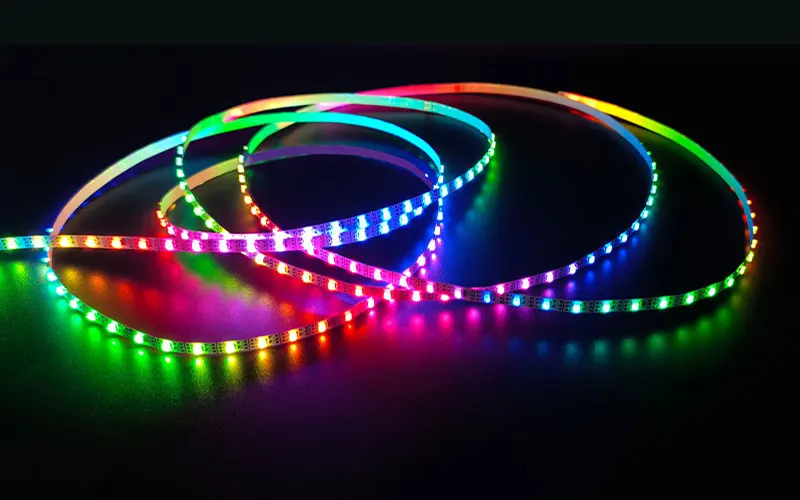
Traditional LED strips (such as 5050 strips) treat all the individual LED beads as a single, unified entity. They typically feature only two power wires—one positive and one negative—meaning the entire strip can display only one color at a time (or change colors in fixed segments). You cannot control any specific individual LED bead within the strip.
Each individual LED on an addressable LED strip (such as the WS2812B) functions as an independent “pixel.” In addition to power lines, these strips feature a dedicated data line. A tiny integrated circuit (IC) is embedded within each LED bead, enabling a controller to address. And specify the color and brightness of—every single LED on the strip via data signals. This capability serves as the foundation for creating complex animation effects, such as chasing lights and rainbow waves.
While traditional LED strips operate through “collective action,” addressable LED strips offer “precise, individual-level control.”
Why Is the IC Types Crucial for Addressable LED Strip?
The IC chip serves as the “brain” of an addressable LED strip—meaning it is its most critical component. It not only dictates how the strip receives signals but also influences its refresh rate, color fidelity, compatibility, and overall stability.
Different types of IC chips utilize distinct data protocols (such as single-wire control or SPI control) and have varying requirements regarding voltage, current, and controller specifications.
For instance, the WS2811 is an external IC that offers high control precision but involves more complex wiring; the WS2812, conversely, integrates the IC directly into the LED package. Making installation much simpler; the SK6812 builds upon the WS2812’s compatibility while adding RGBW functionality, enabling the creation of more nuanced and refined white light blends.
Selecting the wrong IC type can result in the LED strip failing to light up, unstable signal transmission, or incorrect color display. Therefore, understanding the specific type and performance characteristics of the IC chip is a crucial step before purchasing any addressable LED strip.
What are the Common Types of Addressable LED Strip IC?
There are numerous brands of addressable LED strip IC types on the market, with each brand offering multiple series and models. Understanding the fundamental characteristics of these mainstream ICs is the first step toward making the right choice.
WS Series: WS2811, WS2812, WS2813, WS2815
The WS series represents the most popular family of addressable LED ICs on the market. The WS2811 is an external driver chip—typically, a single chip controls three LEDs—operating at 12V, making it well-suited for long-distance signal transmission. The WS2812 and WS2812B integrate the driver chip directly into the 5050 LED package; operating at 5V, each LED is independently controllable, making them the preferred choice for DIY projects.
The WS2813 features an improved data transmission mechanism that incorporates a backup data line function. If a specific LED fails, the signal can bypass the faulty point and continue transmitting, thereby significantly enhancing system reliability. The WS2815, meanwhile, supports a 12V operating voltage while retaining the capability for independent control of each individual LED. Making it ideal for commercial installations requiring long-distance wiring. These chips utilize a single-wire communication protocol with a data transmission rate of approximately 800 kHz and support 24-bit RGB color depth.
SK Series: SK6812, SK9822
The SK6812 is a direct competitor to the WS2812. Its primary advantage lies in the availability of an RGBW version. Which adds a dedicated white LED to the standard RGB triad, enabling the production of purer whites and richer color expressions. In terms of timing requirements, the SK6812 is highly similar to the WS2812 and can serve as a direct drop-in replacement in most scenarios, though its price is typically slightly higher.
The SK9822 represents the high-end tier of the SK series, utilizing a dual-wire SPI interface—similar to that of the APA102. It supports higher refresh rates and longer transmission distances, while offering superior timing tolerance, making it well-suited for professional-grade applications. Its global brightness control feature allows for the adjustment of overall brightness without altering color ratios—a capability particularly useful in PWM dimming applications.
APA Series: APA102
The APA102 utilizes a two-wire SPI communication protocol, consisting of separate data and clock lines. This design offers significant performance advantages: data transmission rates can reach up to 30 MHz—far exceeding those of single-wire protocol ICs—and refresh rates can easily reach several kilohertz. More importantly, the SPI protocol exhibits excellent timing tolerance, allowing it to be easily driven by virtually any microcontroller.
The APA102 also features 5-bit global brightness control, enabling the adjustment of overall brightness while maintaining color accuracy, thereby preventing color distortion issues that often occur at low brightness levels. These characteristics make it an ideal choice for professional projects requiring high refresh rates, precise color control, and large-scale deployment—despite its relatively higher cost.
Others: TM1804, UCS1903, SM16703PB, etc.
The TM1804 is an early-generation addressable LED driver IC that supports a 12V operating voltage and is typically used for controlling RGB modules. Similarly, the UCS1903 is comparable to the WS2811; it utilizes an external driver architecture and therefore offers a cost-effective solution. Meanwhile, the SM16703PB employs a single-wire protocol and supports PWM dimming, making it commonly found in certain cost-sensitive applications.
Key Differences Between WS2811, WS2812, and SK6812
These three models are common IC types found in addressable SPI LED strip; you can select the one that best suits your specific needs. Their differences are primarily reflected in the following aspects:
| Comparison Items | WS2811 | WS2812 | SK6812 |
| IC Location | External | built-in | built-in |
| Voltage | 12V | 5V | 5V |
| Control Method | Single-Wire Control | Single-Wire Control | Single-Wire Control |
| Control the LEDs Quantity | Each IC controls three LEDs. | Each IC controls one LED. | Each IC controls one LED. |
| Color Types | RGB | RGB | RGB/RGBW |
| Anti-interference capability | Strong | Moderate | Fairly Strong |
| Application Scenarios | Large-scale Outdoor or Long-distance Projects | Interior Decoration, DIY LED Strips | High-quality Indoor Lighting, RGBW Projects |
- The WS2811 is better suited for large-area or long-distance installations;
- The WS2812 is the most cost-effective, general-purpose option;
- The SK6812 is an upgraded version designed for those seeking high-quality lighting effects.
How to Choose the Right IC Type for Your Project?
When you decide to purchase addressable (individually controllable) LED strips, the specific IC type is a crucial factor to consider. You can refer to the details below to guide your selection.
Define Project Requirements
To begin with, list the project’s core requirements: for example, how many LEDs need to be controlled, what kind of animation effects and refresh rates are required, and whether pure white light or RGBW color mixing is necessary. In addition, consider whether the operating environment is indoors or outdoors, what the project’s budget range is, and what the requirements are regarding ease of maintenance. Ultimately, the answers to these questions will directly point toward a specific IC type.
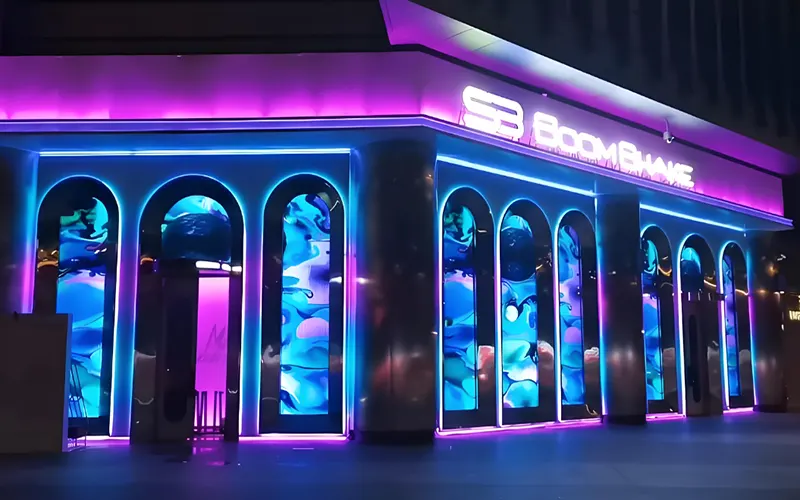
For example, if you are creating a 10-meter-long outdoor architectural outline light strip with 30 LEDs per meter, the 12V WS2811 is the obvious choice—suited for long distances, medium density, and outdoor environments. If it is a desktop decorative light strip—2 meters long with 60 LEDs per meter. And requires rich rainbow animation effects, the 5V WS2812B is the most suitable option—ideal for short distances, low cost, and extensive resource availability.
Evaluating Controller Compatibility
Select your target IC type based on your specific controller. For example, the WS2812 series boasts the most extensive library support and community resources. And as a result, mature driver libraries are available for nearly every platform. On the other hand, the APA102, with its versatile SPI interface, can be easily driven by any controller that supports hardware SPI.
Specific Functional Requirements
If your project has specific functional requirements, these factors may directly dictate your choice of IC. First, do you require truly pure white light? If so, choose the SK6812 RGBW. Next, do you need an ultra-high refresh rate to eliminate camera flicker? In that case, choose the APA102. Additionally, if you require long-distance transmission capabilities, then choose the 12V WS2811 or WS2815. Finally, if you demand the highest level of reliability, you should opt for the WS2813.
Conclusion
The core of an addressable LED strip lies in the choice of its IC types chip. Different ICs determine the strip’s expressive capabilities, control methods, and stability. From the WS2811 to the SK6812, each chip offers its own unique advantages and application scenarios. If you are looking for high-quality addressable LED strips, controllers. Or technical solutions, we invite you to contact our technical consultants for personalized recommendations. We are here to help you achieve smarter, more exceptional lighting designs!
FAQs
Theoretically, a single data line can support a very large number of LEDs in series (such as 1,024 or even more). However, practical limitations primarily stem from power supply capacity and refresh rate constraints.
The WS2811 is an external IC; typically, each IC controls three LEDs and is commonly used in 12V LED strips. In contrast, the WS2812 features a built-in IC. Allowing each individual LED to be controlled independently, and operates at a voltage of 5V. Simply put, the WS2811 is better suited for long-distance LED strips. While the WS2812 is more suitable for applications requiring high-precision control.
Yes, the SK6812 and WS2812 are fully compatible in terms of signal protocol; both utilize a single-wire control method. The difference lies in the fact that the SK6812 features an additional white light channel (RGBW), allowing it to produce a more natural white light effect.
Most addressable LED strips can be cut at designated cutting points. These cutting locations are typically marked directly on the strip (indicated by a scissor icon). If you need to reconnect the strip after cutting, please use soldering or specialized connectors, and ensure that the signal direction is correct.
If the LED strip exceeds 5 meters in length, it is recommended to choose the WS2811 or WS2815. Both of these ICs operate on a 12V power supply, which results in lower voltage drop and greater signal stability, making them ideal for large-scale projects or architectural lighting applications.