
For addressable magic LED strips, there are different IC profiles. Some RGB strips suddenly stop working due to the failure of a single tiny LED chip, completely extinguishing the latter half. This frustrating “single-point failure” problem is a common pain point for LED enthusiasts using the classic WS2812 LED strip. Is there an RGB LED strip that can maintain its vibrant effect and provide greater reliability even after a single chip fails? The answer is the WS2813. This article will delve into the core differences between the WS2812 vs WS2813, from internal structure to practical applications, helping you thoroughly understand how to choose between the two and make the wisest choice for your next project.
What are WS2812 vs WS2813 LED Strips?
Before delving into a comparison, we first need to understand the attributes of these two LED light strips. They both belong to the “addressable RGB LED” family, meaning you can control each LED on the strip to display a different color and brightness individually, creating dynamic and smooth lighting effects.
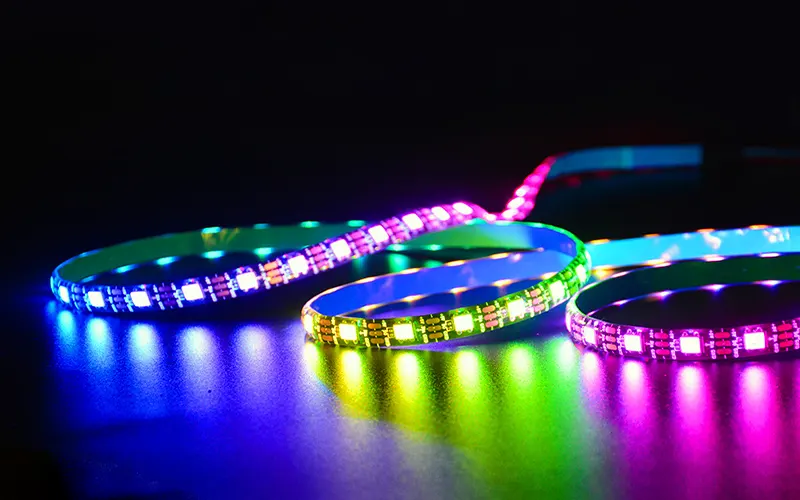
WS2812B (also Called WS2812)
The WS2812 is a very common digital LED strip light. Since its introduction, it has captured a large share of the DIY and commercial lighting market thanks to its mature technology, stable performance, and highly competitive price.
A single WS2812 LED integrates an RGB chip and a control chip, transmitting signals via a single data cable (DIN).
WS2813
It is widely regarded as an upgraded or enhanced version of the WS2812, offering even better performance. Its design goal is very clear: to inherit all the advantages of the WS2812 while addressing its most fatal weakness—the single point of failure.
The WS2813 achieves higher stability and fault tolerance by introducing an innovative dual-data-line backup design.
What are the Main Differences Between the WS2812 vs WS2813?
Both the WS2812 vs WS2813 are LED strip lights, but their differences are quite significant. The WS2813 can be considered an upgrade of the WS2812, but it is slightly more expensive.
Signal Transmission Method
The WS2812 uses a single data line to transmit control signals, meaning each LED chip must communicate serially.
The WS2813 improves upon this design by using dual signal lines (Data and Backup Data). Even if one signal line fails, the backup signal line ensures uninterrupted data transmission, increasing fault tolerance.
Fault Tolerance
With the WS2812, if one LED chip fails, the entire LED strip may be affected, causing subsequent LEDs to malfunction.
The WS2813, however, introduces a backup signal line, allowing other LEDs to continue operating even if one LED chip fails. Therefore, the WS2813 is more reliable in large-scale applications, especially in outdoor environments or large installations.
Performance and Stability
The WS2812 has relatively low stability, especially during long-distance data transmission, where signal attenuation can lead to LED control instability or failure.
The WS2813, with its dual-signal-line design, effectively avoids signal attenuation and interference, ensuring stability over long distances or in complex layouts.
Controller Compatibility
The WS2812 and WS2813 are very similar in use, but due to different signal transmission methods, it may be necessary to check whether the controller supports dual signal line inputs, especially for the WS2813, as some older controllers may not be compatible.
What’s Upgraded from WS2812 to WS2813?
The WS2813 is not a simple iteration, but a precise upgrade addressing key pain points. It significantly improves upon the shortcomings of the WS2812. This is mainly reflected in the following aspects:
Dual Data Cable Design
This is the most crucial upgrade. In addition to the main data input (DIN) and output (DOUT), the WS2813 adds backup data input (BIN) and output (BOUT). Each LED simultaneously listens to both DIN and BIN signals, prioritizing DIN. When an anomaly is detected in the DIN signal, it seamlessly switches to the BIN signal, ensuring the normal operation of subsequent LEDs.
Enhanced System Reliability
This design makes the WS2813 ideal for scenarios where maintenance is difficult or uninterrupted operation is required, such as large commercial decorations, permanent architectural lighting, and long-distance light strip installations. The failure of a single LED no longer means the failure of the entire project.
Improved Signal Processing Capabilities
The WS2813 typically features better signal interference immunity and wider voltage tolerance, which allows the signal to remain stable during long-distance transmission, reducing the problem of flickering or discoloration of the terminal LEDs caused by “signal attenuation”.
Can the WS2812 vs WS2813 Use the Same Controller?
Yes, the WS2812 vs WS2813 can absolutely use the same controller. This is a crucial advantage and a major reason for the rapid market acceptance of the WS2813.
- Software Compatibility: The WS2813 is designed to fully comply with the WS2812’s communication protocol. This means that all code, libraries (such as Arduino’s FastLED and NeoPixel libraries), and various off-the-shelf controller programs written for the WS2812 can be used directly with the WS2813 without any modification. They use the same data format and timing.
- Hardware Connection Notes: Although the controller is universal, special care is needed when wiring. For the WS2813, you need to connect its main data line (DIN) to the controller’s data output. The backup data line (BIN) usually needs to be connected to the BOUT of the previous LED, or shorted to DIN at the first LED. Please refer to the specific datasheet for the WS2813 LED strip you purchased.
Choosing between WS2812 and WS2813: Which is better?
When choosing between the WS2812 and WS2813, you’ll likely consider which is best suited for your lighting project. Returning to the core question: which is better? The answer is: there’s no absolute “better,” only “more suitable.”
If your project prioritises cost-effectiveness, is small in scale, and easy to maintain, then the WS2812B is a time-tested and highly reliable choice.
If you require the highest reliability and stability, have a large-scale project with high maintenance costs, or simply don’t want to bear the risk of a single point of failure, then the WS2813 is undoubtedly a superior and more professional choice.
For most serious, commercial, or large DIY projects, we recommend the WS2813. The peace of mind it provides far outweighs its additional cost.
Conclusion
A comprehensive comparison of the WS2812 vs WS2813 essentially boils down to a trade-off between cost and reliability. The WS2812 is an economical and practical digital LED strip suitable for low-budget and simple applications. The WS2813, with its dual-signal-line design, offers higher reliability and greater fault tolerance, making it particularly suitable for projects with high stability requirements.
Browse our curated selection of high-quality WS2812 and high-reliability WS2813 strips for detailed specifications and real-time pricing.
FAQs
Yes, they are fully compatible, and no code rewriting is required. The WS2813 is designed to fully comply with the WS2812’s communication protocol.
Yes, WS2812 and WS2813 can use the same controller. They use the same communication protocol; the main difference is that WS2813 adds a spare data line.
Yes, the WS2813 is more expensive. This is because the WS2813 uses a dual-signal-line design and has higher fault tolerance, resulting in a slightly higher price compared to the WS2812.
There is no substantial difference in brightness; this is determined by power consumption. The WS2812B and WS2813 typically use the same 5050 RGB LED chip.
Normally, it cannot be driven directly. The traditional WS2813 chip operates at 5V. If your project requires a 12V power supply to reduce voltage drop over long distances, you should consider using an upgraded 12V version of the WS2813, such as the WS2815.